
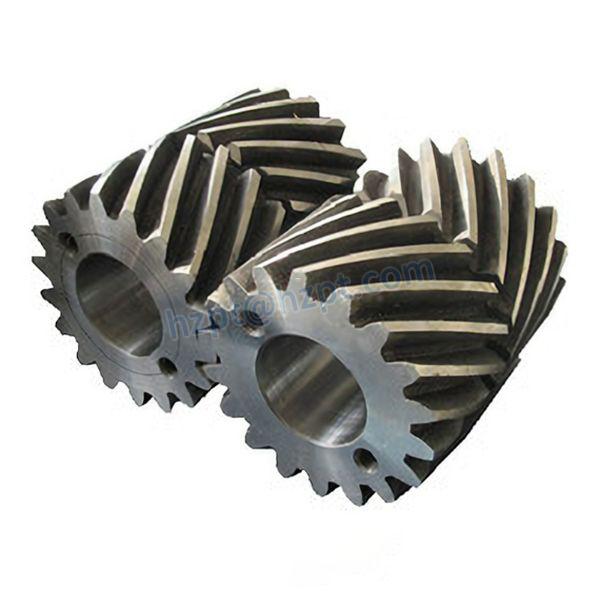
Herringbone gears, also known as double helical gears, represent a pinnacle of engineering design for transmitting high torque and power between parallel shafts with exceptional smoothness and reliability. At Raydafon Group, we specialize in the precision manufacturing of custom herringbone gears tailored to the most demanding industrial applications. Unlike standard helical gears, the unique V-shaped, double-helical tooth design cancels out axial thrust forces, allowing for higher load capacity, minimal vibration, and quieter operation at high speeds. This makes them an indispensable solution for heavy-duty industries such as marine propulsion, power generation, steel rolling mills, and large-scale compressors.
The superior performance of our herringbone gears stems from their distinct design and our commitment to advanced manufacturing. Here are the core benefits:
Raydafon Group manufactures herringbone gears to exact customer specifications. Our capabilities cover a vast range of sizes, materials, and precision grades. Below is an overview of our standard and custom manufacturing parameters.
Material choice is critical for performance, durability, and application suitability. We offer:
| Parameter | Standard Range | Custom Capability | Notes |
|---|---|---|---|
| Module (Metric) / Diametral Pitch (Imperial) | 2 to 30 mm / 1.5 to 12 DP | Up to 50 mm / Down to 0.5 DP | Defines tooth size. Larger modules for heavier loads. |
| Outer Diameter (OD) | 50 mm to 1500 mm | Up to 4000 mm | Diameter of the gear blank. |
| Face Width | 20 mm to 400 mm | Up to 800 mm | Total width including both helices. Wider face increases load capacity. |
| Helix Angle | 15° to 30° (per helix) | 10° to 45° (per helix) | Standard angles optimize smoothness and strength balance. |
| Pressure Angle | 20° (Standard), 14.5° | Custom angles available | 20° offers higher strength and reduced undercutting. |
| Quality Grade (AGMA/ISO) | AGMA 10-12 / ISO 6-8 | Up to AGMA 14 / ISO 3 | Defines gear accuracy. Higher grades for high-speed, low-noise applications. |
| Heat Treatment | Carburizing, Induction Hardening, Nitriding, Through Hardening | Full range including specialized coatings | Tailored to enhance surface hardness, wear resistance, and core toughness. |
| Finishing Processes | Grinding, Shaving, Honing | Superfinishing, Polishing | Critical for achieving high accuracy, surface finish, and noise reduction. |
We don't just supply gears; we provide engineered power transmission solutions. Our design process includes:
Q: What is the main functional difference between a herringbone gear and a double helical gear?
A: There is no functional difference; the terms are synonymous. "Herringbone" refers to the visual V-pattern resembling a fish skeleton, while "double helical" describes the two opposing helical teeth on the same gear body. Both terms describe the same gear type that cancels axial thrust.
Q: Why are herringbone gears more expensive than single helical gears?
A: The manufacturing process for herringbone gears is significantly more complex. It requires specialized machinery capable of cutting the two opposing helices, often with a central groove (gap) for tool clearance. The precision needed to align both helices perfectly is higher, and the processes for heat treatment and finishing are more demanding, all contributing to a higher cost for a superior product.
Q: Can Raydafon Group manufacture a continuous (no central gap) herringbone gear?
A: Yes, we have the capability. True continuous herringbone gears, where the teeth form a seamless "V", require highly specialized gear hobbling or shaping machines. While more challenging and costly to produce, they offer a marginally larger active face width. We assess the necessity for a continuous design versus a grooved design based on your specific load and space requirements.
Q: What are the typical applications where herringbone gears are the preferred choice?
A: They are the gear of choice for high-power, high-torque, and high-speed applications where smooth, reliable operation is critical. Common applications include:
Q: How do I specify a herringbone gear for a quote from Raydafon Group?
A: To provide an accurate and timely quote, please prepare the following information:
Q: What quality control measures does Raydafon Group implement?
A> Quality is integral to our manufacturing process. Our QC protocol includes:
Q: Are there any limitations or disadvantages to using herringbone gears?
A: The primary limitations are cost and manufacturing complexity, as mentioned. Additionally, they are generally not suitable for applications requiring gear shifts or axial movement, as the opposing helices lock the gear axially. For lower-power applications where axial thrust can be managed with bearings, a single helical gear may be a more cost-effective solution.
Q: Does Raydafon Group provide repair or reconditioning services for worn herringbone gears?
A> Absolutely. We offer comprehensive gear repair and reconditioning services. This can include rebuilding worn tooth profiles through welding and re-machining, re-grinding heat-treated gears, and restoring critical dimensions. Our engineers can assess a worn gear and recommend the most economical solution, whether repair or replacement.

 Raydafon