High quality commercial chains from a trusted manufacturer in China
Commercial chains are the unheralded workhorses of modern industry, powering the essential movement of materials, products, and machinery across countless sectors. From the towering elevators in grain silos to the precise indexing of packaging lines, their reliability directly impacts operational efficiency, safety, and the bottom line. As a foundational component in material handling, power transmission, and conveying systems, selecting the correct commercial chain is not a mere procurement task—it is a critical engineering decision. With over two decades of expertise in industrial power transmission, Raydafon Group stands at the forefront of designing, manufacturing, and supplying premium-grade commercial chains engineered for durability, performance, and value.
### The Anatomy of a High-Performance Commercial Chain
Understanding the key components and parameters of a commercial chain is essential for specifying the right product for your application. A standard roller chain, the most common type of commercial chain, is comprised of several precision-made parts:
* **Side Plates:** The outer links that hold the assembly together, designed to withstand tensile loads.
* **Pins & Bushings:** The inner linkage that allows for articulation, hardened for wear resistance.
* **Rollers:** Rotate around the bushings, engaging with the sprocket teeth for smooth power transmission.
* **Cotter Pins / Retaining Clips:** Secure the side plates, maintaining chain integrity.
Beyond these components, the performance and suitability of a chain are defined by its technical specifications.
### Critical Product Parameters and Specifications
When evaluating commercial chains, engineers and maintenance professionals must consider a comprehensive set of parameters. The following list and table detail the core specifications provided by industry leaders like Raydafon Group.
**Key Parameters List:**
* **Pitch:** The distance between the centers of two adjacent pins. This is the most fundamental dimension, defining the chain size (e.g., ANSI 40, 50, 60).
* **Breaking Strength:** The maximum tensile load a chain can withstand in a single pull test before failure. This is a critical safety margin.
* **Average Ultimate Strength:** A more practical measure of the maximum load the chain can repeatedly handle under normal operating conditions.
* **Working Load Limit (WLL):** The recommended maximum load for safe and continuous operation, incorporating a design safety factor.
* **Material & Heat Treatment:** Typically alloy steel (e.g., carbon steel, nickel-plated). Heat treatment processes like case hardening or through hardening are applied to pins, bushings, and rollers for enhanced wear life.
* **Lubrication Type:** Specifications for standard, pre-lubricated, or self-lubricating (o-ring, x-ring) chains for different environmental conditions.
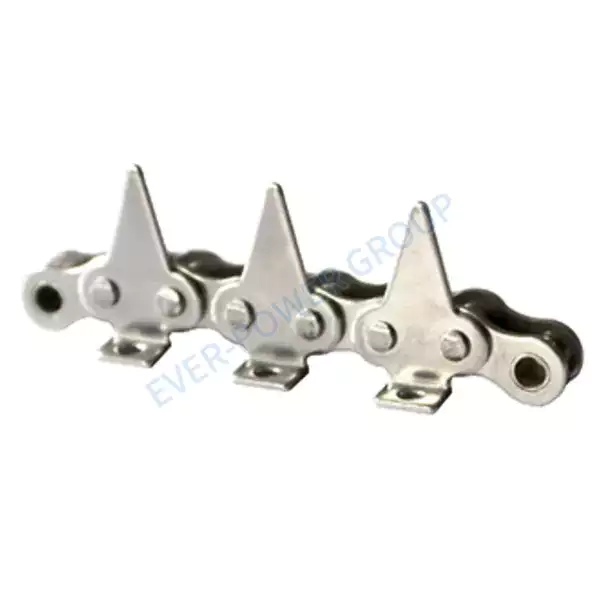
* **Attachment Options:** Availability of standard or custom attachments (bent tabs, straight tabs, etc.) for conveying applications.
| Parameter | Description | Industry Standard Example (ANSI Series) | Raydafon Group Enhancement |
| :--- | :--- | :--- | :--- |
| **Chain Size (Pitch)** | Defines the basic dimensions and compatibility with sprockets. | ANSI 40 (0.5" Pitch), ANSI 50 (0.625" Pitch), ANSI 60 (0.75" Pitch) | Precision manufacturing ensures pitch consistency, reducing sprocket wear. |
| **Breaking Strength** | Ultimate failure point in a static test. | ANSI 50: ~7,700 lbs | Advanced metallurgy and forging techniques yield strengths exceeding standard ANSI ratings. |
| **Working Load Limit** | Safe operational load with a built-in safety factor. | Typically 1/6 to 1/9 of Breaking Strength. | Clear, conservative WLL ratings provided for each product, ensuring compliance and safety. |
| **Material Specification** | Base steel composition and protective finishes. | Carbon Steel, Stainless Steel (304/316), Nickel-Plated. | Proprietary alloy blends and controlled heat treatment processes for optimal hardness and toughness. |
| **Hardeness (Pin/Bushing)** | Resistance to deformation and wear. | Case hardened to specific Rockwell (RC) scales. | Through-hardening options available for extreme abrasion resistance in harsh environments. |
| **Lubrication** | Internal friction reduction and corrosion protection. | Standard dip lubrication. | Advanced sealed lubrication (RIV-Series) with nitrile rubber rings retains grease and excludes contaminants. |
### Applications Across Industries
The versatility of commercial chains is demonstrated by their widespread use. Raydafon Group supplies chains tailored to the unique demands of each sector:
* **Material Handling & Conveying:** Distribution centers, airport baggage systems, automotive assembly lines, and postal sorting facilities.
* **Food & Beverage Processing:** Stainless steel or plastic-coated chains for wash-down environments in bottling, canning, and packaging.
* **Agricultural Machinery:** Heavy-duty chains for combines, conveyors, and elevators, resistant to dust and organic debris.
* **Industrial Manufacturing:** Drive chains for machinery, indexers, and production line equipment requiring precise timing and power.
---
### Commercial Chains: Frequently Asked Questions (FAQ)
**What is the difference between a "drive" chain and a "conveyor" chain?**
While often mechanically similar, the primary difference lies in their function. A drive chain is designed to transmit power from a motor to a driven component, focusing on high tensile strength and fatigue resistance under load. A conveyor chain is designed to carry products or materials along its length, often featuring attachments and prioritizing smooth, stable movement with less emphasis on high-speed power transmission.
**How often should I lubricate my commercial chain, and what type of lubricant should I use?**
Lubrication frequency depends entirely on the operating environment (speed, load, temperature, presence of contaminants). A general rule for standard chains in moderate conditions is every 8 hours of operation. Use a high-quality, penetrating chain lubricant designed for metal-on-metal contact. For sealed chains (O-ring/X-ring) from Raydafon Group, lubrication is sealed in at manufacture, significantly extending maintenance intervals—often only requiring occasional external cleaning and inspection.
**How do I correctly measure chain wear to determine when it needs replacement?**
The most accurate method is to measure the chain's pitch elongation. Stretch a section of chain under slight tension and measure the length between 10 or 20 links. Compare this to the new chain's nominal length (Pitch x Number of Links). If the elongation exceeds 1.5-2%, the chain is worn and should be replaced, as worn chains accelerate sprocket wear and can fail unpredictably.
**Can I mix chains and sprockets from different manufacturers?**
It is strongly discouraged. While ANSI standards define basic dimensions, subtle variations in tooth profile, hardening processes, and tolerances between manufacturers can lead to accelerated wear, increased noise, and premature failure. For optimal system life and performance, Raydafon Group recommends using matched chains and sprockets designed to work together seamlessly.
**What does the "ANSI" number in chain sizing mean (e.g., ANSI 40, ANSI 80)?**
ANSI (American National Standards Institute) numbers are a standardized code for roller chain dimensions. The number roughly corresponds to the pitch in eighths of an inch. An ANSI 40 chain has a 4/8" (0.5") pitch. An ANSI 80 chain has an 8/8" (1.0") pitch. Higher numbers indicate larger, heavier-duty chains.
**What are the advantages of using sealed (O-Ring/X-Ring) chains?**
Sealed chains incorporate rubber rings seated between the side plates that seal lubricant inside the pin and bushing area while keeping dirt, grit, and moisture out. This dramatically reduces internal wear, extends service life by up to 5-10 times in dirty environments, reduces the need for frequent re-lubrication, and maintains consistent performance. Raydafon Group's sealed chains are engineered for maximum seal integrity and lubricant retention.
**How do I select the correct chain size for my application?**
Selection requires calculating several factors: the transmitted horsepower (for drives) or total conveyed load (for conveyors), the speed of operation (RPM), the size of the connected sprockets (number of teeth), and the service conditions. Raydafon Group provides detailed engineering catalogs and application support to guide customers through this process, ensuring the selected chain has adequate strength, wear life, and safety factor.
**What are the signs of a failing or poorly maintained chain?**
Visible signs include excessive sag or "stretch," stiff links that do not articulate freely, visible wear or "hooking" on the sprocket teeth, rust or corrosion, and unusual noises like squeaking or rattling during operation. Regular visual and manual inspections are the best preventative measures.
**Does Raydafon Group offer corrosion-resistant chains for harsh environments?**
Absolutely. Beyond standard carbon steel, Raydafon Group offers a full range of chains in stainless steel (Grades 304 and 316 for high corrosion resistance), nickel-plated chains for moderate chemical exposure, and even plastic-coated chains for the food and chemical industries where product contamination or wash-down procedures are a concern.
**What is the lead time for custom-configured chains with special attachments?**
Lead times for custom chains vary based on the complexity of the attachment and the quantity ordered. Standard custom attachments often have a lead time of 4-6 weeks from order confirmation. Raydafon Group's manufacturing flexibility and global logistics network are dedicated to minimizing lead times while maintaining the highest quality standards.
We use cookies to offer you a better browsing experience, analyze site traffic and personalize content. By using this site, you agree to our use of cookies.Privacy Policy


 Raydafon