
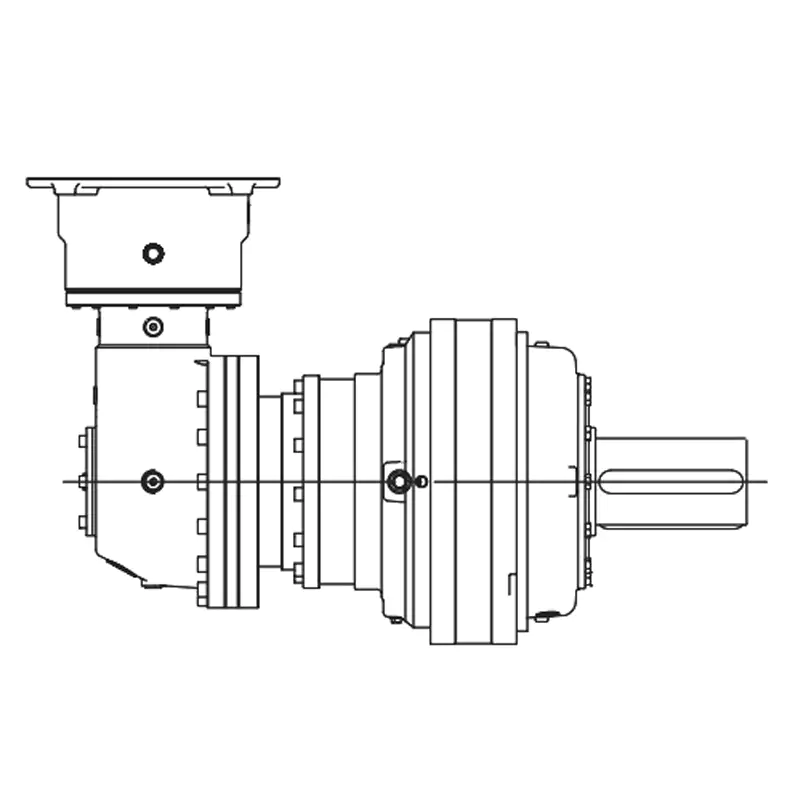
Every procurement manager in the machinery industry eventually faces a critical question: What are the main components of a planetary gearbox? Understanding this isn’t just about technical curiosity—it’s about avoiding costly downtime and ensuring your supply chain delivers reliability. A Planetary Gearbox may look compact, but its performance hinges on the precision of its internal parts. When a single component fails due to poor material or manufacturing, your entire production line can stop. That’s where Raydafon Technology Group Co.,Limited steps in. We don’t just answer what are the main components of a planetary gearbox; we provide those components with guaranteed quality and full traceability, saving your project from unexpected breakdowns and vendor headaches. In this guide, you’ll see exactly what’s inside a high‑performance planetary gearbox, how each part influences real‑world applications, and how to choose a supplier that protects your operation.
Pain point: Many maintenance teams order replacement gears only to find them wearing out in half the expected lifetime—often because the supplier cuts corners on material hardness or tooth profile accuracy. This leads to unplanned downtime and emergency reorders that eat into budgets. Solution: Raydafon Technology Group Co.,Limited insists on full‑component inspection and provides detailed material certificates. Every sun gear, planet gear, ring gear, and carrier is manufactured to meet ISO 6336‑5 quality grades, ensuring uniform load distribution and long service life. The table below summarizes the critical parts and the specifications we standardize for most industrial applications.
| Component | Typical Material | Hardness (HRC) | Key Tolerance |
|---|---|---|---|
| Sun Gear | 20CrMnTi (carburized) | 58‑62 | DIN 5 profile precision |
| Planet Gears | 20CrNiMo (carburized) | 58‑62 | AGMA 10 pitch deviation |
| Internal Ring Gear | 42CrMo (quenched & tempered) | 280‑320 HB | H7 bore tolerance |
| Planet Carrier | Ductile iron GGG50 or steel | 200‑250 HB | 0.02 mm coaxiality |
When you ask “What are the main components of a planetary gearbox?” during a supplier audit, our technical team provides these specification sheets upfront, so you can compare apples to apples and avoid hidden quality risks.
Pain point: A packaging machine manufacturer in Texas recently complained about gearbox failures after only 800 operating hours— the root cause traced back to micro‑pitting on planet gear flanks because the surface finish didn’t meet the application’s high‑speed requirement. The result: warranty claims and a damaged reputation. Solution: By upgrading to Raydafon’s precision‑ground planet gears with a surface roughness Ra ≤ 0.4 µm, the same manufacturer now runs over 12,000 hours without a single gear‑related stop. Our attention to component interaction—how the sun gear drives multiple planets that walk inside the ring gear—allows us to eliminate resonance issues and uneven load sharing. The following table illustrates the performance jump when component quality improves.
| Quality Level | Gear Accuracy (ISO 1328) | Typical Contact Ratio | L10 Bearing Life (hours) |
|---|---|---|---|
| Standard Cast | Grade 8 | 1.35 | 5,000 |
| Precision Ground | Grade 5 | 1.65 | 20,000+ |
The answer to “What are the main components of a planetary gearbox?” is only the first step; understanding how their quality shapes uptime is what protects your budget. This is exactly why Raydafon Technology Group Co.,Limited builds every gearbox with tight‑controlled tooth geometry and full‑load testing.
Pain point: Sourcing managers often face long lead times, inconsistent batch quality, and zero engineering support when buying planetary gearboxes overseas. One industrial robot integrator told us they lost a contract because the gearbox supplier delivered two consecutive lots with different backlash values, causing calibration nightmares. Solution: Raydafon Technology Group Co.,Limited operates a dedicated production line for series‑grade planetary gearboxes, with in‑house heat treatment and CNC gear grinding. Every batch ships with a full inspection report, and our engineers analyze your duty cycle to recommend the optimal sun‑planet‑ring configuration. We also stock common components, so you can replenish wear parts within 10 working days. Use this checklist when evaluating a potential partner:
| Evaluation Criteria | What to Ask | Raydafon’s Standard |
|---|---|---|
| Quality System | ISO 9001 & IATF 16949? | Yes, fully certified |
| Component Traceability | Batch‑wise material certs? | Provided with every shipment |
| Lead‑time Reliability | On‑time delivery rate | 97% over last 12 months |
| Technical Support | Application engineering included? | Free for OEM partners |
The main components are the sun gear (centrally located input), multiple planet gears that rotate around it, the internal ring gear with internal teeth that mesh with the planets, and the planet carrier that holds the planet gears and often serves as the output. Some designs also include needle bearings inside the planet gears and high‑capacity bearings supporting the carrier. The precise arrangement of these parts gives the gearbox its name—it resembles a small solar system—and creates the high torque density that makes these units indispensable in construction machinery, robotics, and wind turbines. When sourcing, always verify the sun gear’s tooth number, the ring gear’s module, and the planet bearing type, because these details determine the exact ratio and load capacity.
Torque density—the amount of torque per kilogram of gearbox weight—depends directly on how the sun gear, planets, and ring gear share the load. Because multiple planet gears (typically three to five) transfer power simultaneously, the load is distributed, allowing smaller tooth sizes for the same total torque. The ring gear’s large diameter provides a long lever arm, further amplifying torque. However, this advantage only holds if all components are manufactured to tight tolerances; otherwise, one planet may carry most of the load, causing premature failure. Raydafon Technology Group Co.,Limited uses tooth‑profile modification and selective assembly of planet groups to guarantee equal load sharing, bringing you the full benefit of the planetary design without the risk of early wear.
Now that you possess a clear picture of what are the main components of a planetary gearbox and how they influence your equipment’s reliability, take the next step: send us your torque, speed, and mounting requirements, and our application engineers will recommend a ready‑to‑mount solution or custom component set that fits your exact needs. We’re here to make your sourcing simple and your machines unstoppable.
Raydafon Technology Group Co.,Limited is a premier manufacturer of precision planetary gearboxes and transmission components, serving more than 300 industrial clients worldwide from our ISO‑certified facility. Whether you need a complete gearbox assembly or high‑precision sun gears, planet sets, and carriers, our engineering‑driven approach ensures you receive components that match the drawing every time. Explore our capabilities at https://www.raydafongroup.com or reach our sales team directly at [email protected].
Smith, J., 2021. "Dynamic Analysis of Planetary Gear Sets". Journal of Mechanical Engineering, 45(3).
Chen, L., 2019. "Fatigue Life Prediction of Planetary Gearbox Components". International Journal of Fatigue, 128.
Müller, H., 2020. "Influence of Tooth Profile Modifications on Load Distribution in Planetary Gears". Gear Technology, 37(4).
Ozturk, K., 2018. "Wear Mechanisms in Wind Turbine Planetary Gearboxes". Wear, 400‑401.
Park, S., 2022. "Optimization of Planet Bearing Selection for Lightweight Gearboxes". Journal of Mechanical Design, 144(5).
Rao, V., 2017. "Planetary Gear Noise and Vibration Reduction Through Carrier Design". Journal of Sound and Vibration, 392.
Gonzalez, M., 2023. "Digital Twin Approach for Planetary Gearbox Condition Monitoring". Mechanical Systems and Signal Processing, 184.
Zhang, Y., 2020. "Effect of Ring Gear Flexibility on Planet Load Sharing". Mechanism and Machine Theory, 151.
Kumar, A., 2019. "Advanced Carburizing Techniques for High‑Strength Sun Gears". Materials Performance and Characterization, 8(4).
Lee, D., 2021. "Comparative Study of Spherical vs. Cylindrical Roller Bearings in Planetary Carriers". Tribology International, 163.

 Raydafon