
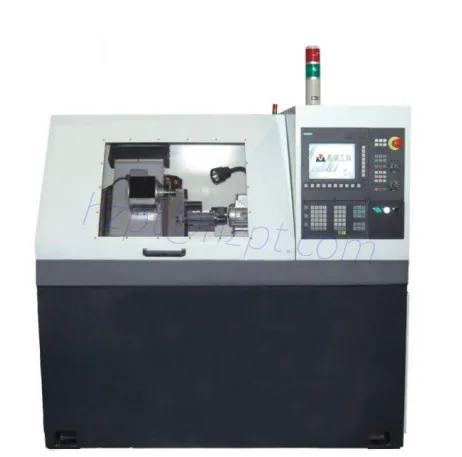
A Grinding Wheel Dressing Machine is an essential piece of equipment in precision machining and grinding operations. Its primary function is to true and dress grinding wheels, restoring their geometric accuracy, sharpness, and cutting efficiency. Over time, grinding wheels become loaded with metal particles (loaded), glazed (dulled), or lose their true shape (out-of-round). A dressing machine uses a single-point diamond or a cluster diamond tool to precisely remove a layer of abrasive material from the wheel's surface, exposing fresh, sharp grains and re-establishing the correct profile. This process is critical for maintaining tight tolerances, achieving superior surface finishes, and ensuring consistent part quality in applications ranging from tool and cutter grinding to cylindrical, surface, and centerless grinding.
With decades of engineering excellence, Raydafon Group has established itself as a leader in precision grinding technology. Our grinding wheel dressing machines are not merely tools; they are integrated solutions designed for maximum reliability, accuracy, and user-friendliness. We understand that downtime is costly. That's why every Raydafon dressing machine is built with robust components, advanced control systems, and failsafe mechanisms to ensure uninterrupted operation in the most demanding industrial environments. Our commitment extends beyond the sale, offering comprehensive technical support, training, and a global spare parts network to keep your productivity at its peak.
Raydafon Group offers a range of grinding wheel dressing machines, from manual models for toolroom applications to fully CNC-controlled systems for high-volume production lines. The following parameters define our core series, the RDD-G Series.
| Parameter | RDD-G100 | RDD-G200 | RDD-G300 | RDD-G400 |
|---|---|---|---|---|
| Max. Grinding Wheel Diameter | 250 mm (10") | 400 mm (16") | 600 mm (24") | Customizable to Host Machine |
| Dressing Tool Spindle Speed | 0 - 5,000 rpm (Variable) | 0 - 8,000 rpm (Variable) | 0 - 12,000 rpm (Servo) | 0 - 10,000 rpm (Servo) |
| Positioning Accuracy (Linear Axes) | ±0.01 mm | ±0.005 mm | ±0.001 mm | ±0.0005 mm |
| Repeatability | ±0.005 mm | ±0.002 mm | ±0.0005 mm | ±0.0002 mm |
| Control System | Manual Handwheels | Digital Readout (DRO) / PLC | Raydafon CNC-8 Controller | Integration Interface (Profibus, Ethernet IP) |
| Axis Configuration | X, Y (Manual) | X, Y, Z (Motorized) | Up to 5 Axes (X,Y,Z,A,C - CNC) | 2-3 Axes (Typically Radial & Traverse) |
| Dressing Tool Holder | Standard ER25 Collet | Standard ER32 Collet | HSK-63A or CAT-40 | Custom Flange Mount |
| Coolant System | Optional Flood Kit | Integrated Pump & Filtration | High-Pressure Through-Spindle Coolant | Utilizes Host Machine Coolant |
| Power Supply | 110/220V, 1-Phase | 220/380V, 3-Phase | 380/480V, 3-Phase | 24-48 VDC / Host Machine Power |
| Machine Footprint (L x W) | 600 x 450 mm | 900 x 750 mm | 1,500 x 1,200 mm | Varies by Integration Design |
Q: How often should I dress my grinding wheel?
A: The dressing frequency depends on several factors: the material being ground (e.g., hardened steel vs. aluminum), the required surface finish, the grinding wheel specification, and the volume of material removed. A glazed wheel (shiny surface) or a loaded wheel (clogged with workpiece material) requires immediate dressing. As a general rule, for consistent quality, implement a scheduled dressing interval based on part count or machining time, as determined by process validation.
Q: What is the difference between truing and dressing?
A: Truing is the process of making the grinding wheel concentric with its axis and restoring its correct geometric shape (e.g., flat face, straight cylinder). Dressing is the process of sharpening the wheel by opening the abrasive grit and removing the bond material to expose fresh, sharp cutting edges. A grinding wheel dressing machine typically performs both operations simultaneously: it trues the wheel to shape and dresses it to sharpness.
Q: Can a Raydafon dressing machine create complex wheel profiles?
A: Absolutely. Our CNC RDD-G300 and G400 series are specifically engineered for complex form dressing. Using our proprietary software, you can program intricate profiles including multi-radius forms, stepped contours, angles, and custom shapes essential for gear grinding, thread grinding, or producing specialized cutting tools. The multi-axis coordination ensures high-fidelity profile replication onto the grinding wheel.
Q: What type of diamond tool should I use with your machines?
A: Raydafon Group machines are compatible with industry-standard single-point, multi-point, and cluster diamond dressers. The selection depends on the wheel specification (grit, bond, hardness) and the desired finish. For general-purpose dressing of vitrified wheels, a high-quality single-point diamond is recommended. For resin or metal-bond wheels, a cluster diamond or NPD (Natural/Polycrystalline Diamond) tool may offer better life and stability. Our technical team can provide specific tooling recommendations for your application.
Q: How does in-process dressing (like the RDD-G400) benefit my production line?
A: In-process dressing systems are game-changers for automated production. By integrating the dressing unit directly onto the grinding machine, the wheel can be dressed within the same machining cycle, without unloading the workpiece or stopping for separate dressing operations. This drastically reduces non-cut time, improves consistency from part-to-part (as the wheel is always in optimal condition), minimizes manual intervention, and is essential for lights-out manufacturing operations.
Q: What kind of maintenance does a Raydafon dressing machine require?
A: Raydafon machines are built for low maintenance. Key routine tasks include keeping the way covers clean, checking and topping up lubrication in linear guideways and ball screws as per the manual (typically every 2,000-4,000 hours), and ensuring coolant (if used) is clean and at the proper concentration. The CNC systems feature built-in diagnostic software. We recommend an annual preventative maintenance check by a certified Raydafon technician to inspect critical alignments, servo parameters, and mechanical wear.
Q: Can your machines dress superabrasive wheels (CBN & Diamond)?
A: Yes, but with specific considerations. Dressing superabrasive wheels often requires different parameters (slower infeed rates, different coolants) and sometimes specialized dressing tools like rotary diamond disc dressers or SiC sticks for "conditioning." Our CNC machines, with their precise servo control and programmable cycles, are ideally suited for this task. It is crucial to consult with Raydafon Group's application engineers to configure the correct process parameters and tooling for your specific superabrasive wheel type and bond.
Q: What support and training does Raydafon Group provide?
A> Our partnership includes comprehensive start-up support: machine installation, calibration, and on-site operator and programmer training. We provide detailed manuals, software guides, and access to our online video tutorial portal. Our global service network offers remote troubleshooting assistance and rapid on-site service if needed. Furthermore, our application engineering team is available for process optimization and custom programming support to ensure you achieve your desired grinding results from day one.

 Raydafon