
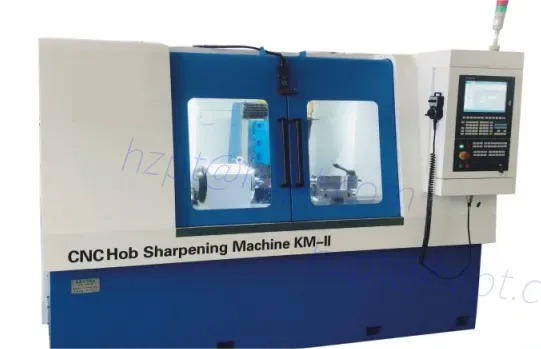
In the high-stakes world of gear manufacturing, the quality and longevity of your cutting tools are paramount. A sharp, precise gear hob is not just a tool; it's the cornerstone of productivity and part accuracy. For decades, the sharpening process was a bottleneck—prone to human error, inconsistent results, and extensive downtime. Today, Raydafon Group shatters these limitations with our state-of-the-art CNC Hob Sharpening Machine. This isn't merely an upgrade; it's a complete transformation of your regrinding workflow, engineered for shops that demand uncompromising precision, repeatability, and return on investment. Our machine embodies over two decades of engineering excellence, bringing fully automated, computer-controlled perfection to the critical task of hob resharpening.
Our CNC hob sharpening solution is designed for manufacturers of automotive transmissions, aerospace components, heavy machinery, and precision instruments. By integrating advanced software with robust mechanical design, the Raydafon machine restores hobs to their original—or even superior—geometric profiles with micron-level accuracy. This ensures your gears maintain perfect tooth form, optimal surface finish, and quiet operation. We understand that your profitability hinges on minimizing tooling costs and maximizing machine uptime. That's why our system is built for speed, simplicity, and extraordinary durability, providing a clear competitive edge in a global market.
The Raydafon CNC Hob Sharpening Machine leverages a closed-loop servo system and high-resolution linear scales to control every axis of movement with unparalleled fidelity. The heart of the system is our proprietary Raydafon SharpSmart software, which allows for intuitive programming of even the most complex hob geometries, including crowned, tapered, and protuberance hobs.
The following tables outline the key specifications and capabilities of the standard Raydafon CNC Hob Sharpening Machine model RHG-800. Custom configurations are available to meet specific production requirements.
| Parameter | Specification |
|---|---|
| Maximum Hob Diameter | 320 mm (12.6 inches) |
| Maximum Hob Length | 800 mm (31.5 inches) |
| Maximum Hob Module (Metric) | M12 |
| Maximum DP (Diametral Pitch) | 2 DP |
| Grinding Wheel Diameter | 150 - 300 mm (6 - 12 inches) |
| Machine Footprint (L x W) | 3,200 mm x 2,100 mm (126" x 83") |
| Net Weight | Approx. 8,500 kg (18,740 lbs) |
| Component | Specification |
|---|---|
| Positioning Resolution | 0.0001 mm (0.000004") |
| Repeatability | ±0.002 mm (±0.00008") |
| Work Head Spindle Speed | 5 - 300 rpm (programmable) |
| X-Axis Travel (Radial) | 400 mm (15.75") |
| Z-Axis Travel (Longitudinal) | 900 mm (35.43") |
| A-Axis Tilt (Wheel Head) | -15° to +90° |
| C-Axis Rotation (Work Head) | 360° continuous |
| Control System | Raydafon SharpSmart CNC with 15" Touchscreen HMI |
What types of hobs can the Raydafon machine regrind?
Our CNC Hob Sharpening Machine is versatile and can regrind a wide array of hob types. This includes straight flute hobs, spiral (single or multi-start) hobs, involute gear hobs, spline hobs, serration hobs, and complex forms like crowned and tapered hobs. The 5-axis CNC capability allows it to generate precise radial and axial relief on the rake face and clearance faces.
How does the CNC automation improve consistency over manual sharpening?
Manual sharpening relies heavily on operator skill, leading to variations in relief angles, flute spacing, and edge quality. The Raydafon CNC machine stores the exact hob geometry in its program. Once a perfect grind is achieved for the first hob, the machine replicates it identically for every subsequent hob, ensuring every tool produces identical gear teeth. This eliminates scrap parts caused by tool inconsistency.
What is the typical time savings compared to traditional methods?
Savings are substantial. A complex hob that might take a skilled tradesperson 4-6 hours to manually regrind can often be completed in 45-90 minutes on our CNC machine, including setup. The automatic wheel dressing and probing drastically reduce non-cutting time. Furthermore, multiple hobs can be run unattended after the first piece is verified.
Can it correct errors from previous sharpening or manufacturing?
Yes, within material limits. The on-machine probing can map the existing flute profile. Our SharpSmart software can then calculate a new tool path to recut the flutes to the correct geometry, often salvaging expensive hobs that were previously ground incorrectly. This is a key feature for tool reconditioning services.
What kind of grinding wheels are recommended, and what is the cost of consumables?
We recommend vitrified-bond CBN (Cubic Boron Nitride) wheels for high-speed steel hobs and diamond wheels for carbide hobs. While the initial cost is higher than aluminum oxide wheels, their wear rate is exceptionally low, providing a much lower cost-per-ground-hob over time. The automatic dresser minimizes wheel wear by using an optimal dressing schedule.
How does Raydafon Group support the machine after installation?
Raydafon Group provides comprehensive global support. This includes on-site installation and training by factory-certified engineers, a detailed library of instructional videos, remote diagnostics support, and a readily available inventory of spare parts. We offer annual maintenance contracts to ensure peak machine performance and longevity.
Is the machine suitable for a job shop environment with many different hob types?
Absolutely. The Raydafon CNC Hob Sharpening Machine is ideal for job shops. The software allows for creating and saving an unlimited number of hob parameter libraries. Changing from one hob to another often requires just calling up a saved program, loading the correct wheel, and performing a quick automatic probe cycle. This enables small batch sharpening to be highly economical.
What are the power and utility requirements?
The standard RHG-800 model requires a 3-phase, 400-480V, 50/60 Hz power supply with a recommended capacity of 50 kVA. It requires a dry, oil-free compressed air supply at 6-8 bar and a standard industrial coolant mixture (oil or water-based) with a central or independent filtration system. Full utility specs are provided during the pre-installation site audit.

 Raydafon