
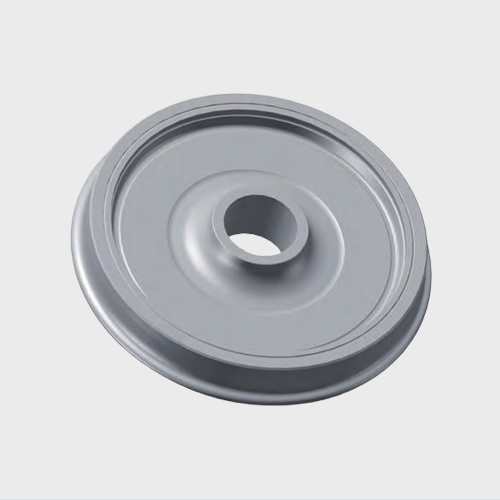
The relentless pursuit of faster, safer, and more efficient rail travel hinges on a single, pivotal component: the high-speed train wheel. Far more than a simple steel disc, it is a masterpiece of precision engineering, a fusion of advanced metallurgy, innovative design, and rigorous testing. At Raydafon Group, with decades of dedication to rail technology, we understand that the wheel is the fundamental interface between a high-speed train and the track. Its performance directly dictates passenger comfort, operational safety, maintenance intervals, and overall network efficiency. This comprehensive guide delves into the intricate world of high-speed train wheels, showcasing the engineering excellence that powers modern rail transport.
A Raydafon Group high-speed train wheel is a system engineered for extreme conditions. Its design addresses the immense forces of acceleration, braking, and lateral guidance at speeds exceeding 250 km/h (155 mph).
Our wheels are manufactured to meet and exceed international standards such as EN 13262, AAR M-107/M-208, and ISO 1005. Below are the detailed parameters for our flagship product line, the Raydafon Veloce Series.
| Parameter | Specification | Notes / Standard |
|---|---|---|
| Nominal Diameter | 860 mm, 920 mm, 950 mm | Custom diameters available upon request |
| Rim Width | 135 mm, 140 mm, 145 mm | Optimized for specific rail profiles |
| Material Grade | RDF-HSW350 (Proprietary Alloy) | Yield Strength ≥ 550 MPa, Tensile Strength ≥ 850 MPa |
| Hardness (Brinell) | 260 - 320 HB | Uniform hardness depth > 30 mm |
| Maximum Design Speed | 400 km/h (249 mph) | Certified for operational service |
| Maximum Axle Load | 17 tonnes | Per wheel, under dynamic conditions |
| Balance Quality | G1.0 per ISO 1940-1 | Ensures ultra-smooth rotation at high speeds |
| Non-Destructive Testing | 100% Ultrasonic & Magnetic Particle Inspection | Guarantees internal and surface integrity |
| Service Life (Target) | 1.2 - 1.5 million kilometers | Depending on track geometry and braking system |
Precision is not an accident; it is the result of a controlled, multi-stage manufacturing process. Raydafon Group's production integrates state-of-the-art technology with seasoned craftsmanship.
Q: Why can't standard railway wheels be used for high-speed trains?
A: Standard wheels are not designed to withstand the unique demands of high-speed operation. At speeds over 250 km/h, factors like centrifugal force, increased thermal loading from braking, dynamic instability, and wheel-rail contact stresses become exponentially more critical. High-speed train wheels use superior materials, more precise geometries, and undergo far stricter quality controls to ensure they remain stable, reliable, and safe under these extreme conditions.
Q: How does the design of a high-speed train wheel improve safety?
A: Safety is engineered into every aspect. The optimized tread profile provides inherent stability, preventing hunting oscillations. The high-strength, fatigue-resistant steel resists crack initiation and propagation. The rigorous non-destructive testing (NDT) protocols guarantee that no defective wheel enters service. Furthermore, the precise balancing minimizes vibrations that could lead to component failure or track damage.
Q: What is "wheel polygonization" and how does Raydafon address it?
A: Polygonization (or out-of-roundness) is a wear phenomenon where the wheel develops flat spots or a polygonal shape, causing severe vibrations and noise. It is a major concern in high-speed operations. Raydafon Group mitigates this through our proprietary steel alloy (RDF-HSW350), which offers superior uniform wear characteristics, and our optimized heat treatment that creates a deeper, more consistent hardness profile. This ensures even wear and dramatically extends the period before re-profiling is needed.
Q: How often do high-speed train wheels need to be maintained or replaced?
A: Maintenance intervals are highly dependent on mileage, track conditions, and braking patterns. Typically, wheels are inspected and measured for wear during regular depot visits. They can be re-profiled (machined back to the correct shape) several times before reaching the minimum diameter limit. A Raydafon Veloce Series wheel is designed for a target service life of 1.2 to 1.5 million kilometers before replacement is necessary, representing a significant reduction in total lifecycle costs.
Q: What are the key factors to consider when selecting a high-speed train wheel supplier?
A: Operators should prioritize proven experience, certification to international standards (EN, AAR, ISO), comprehensive quality assurance and traceability systems, technical support capability, and a robust R&D department. Raydafon Group brings over four decades of specialized focus on rail components, offering not just a product, but a full engineering partnership, from initial design consultation to in-field performance monitoring.
Q: Can Raydafon Group provide wheels for specific or proprietary train models?
A: Absolutely. While our Veloce Series covers many common high-speed applications, a core strength of Raydafon Group is our engineering-to-order capability. Our technical team works directly with OEMs and operators to design and manufacture wheelsets that meet exact specifications for new rolling stock or for legacy fleet upgrades, ensuring perfect compatibility and performance.

 Raydafon