
How Do You Install a Solar Panel Tracker Shaft? Imagine a 90-meter tracker row ready for module installation, but the shafts have arrived with a slight bow. The crew bolts the first bearing, forces the next section into alignment, and strips a coupling thread. Now the tracker drive groans, the row sits at a 2-degree error, and your team spends three extra days with come-alongs and shims. The shaft is not just a steel tube; it is the torque-carrying spine that must hold angular alignment across a long row. For procurement professionals and site engineers, installation quality decides whether you get a smooth commissioning or a sequence of field failures. This guide breaks down how to install a Solar Panel Tracker Shaft correctly, what to inspect before lifting, and how Raydafon Technology Group Co., Limited removes the guesswork with pre-straightened, traceable, and ready-to-fit shafts. Use the clickable outline below to move to the section that matches your current site challenge.
Site teams often treat the torque tube or shaft as a commodity, but it directly controls the tracking accuracy of the entire row. A bent shaft forces bearing misalignment, accelerates drive motor wear, and creates micro-cracks in the galvanized coating. The pain becomes visible when energy yield drops by a few percent, but the mechanical damage may have started months earlier. Raydafon addresses this before installation by supplying shafts with controlled straightness and uniform wall thickness, which reduces the need for field straightening.
From an installation standpoint, a well-made shaft means the bearing saddles slide into position without prying, the coupling bolts align the first time, and the final torque check stays within the drive manufacturer’s limit. That is the difference between a one-day row installation and a three-day corrective loop.
Before any shaft is lifted, walk the row with a simple checklist. You are looking for foundation bolt pattern errors, bent bearing plates, and mismatched shaft sections. The most common field call we hear is that the shaft fits at one end but not the other because the row was laid out with a cumulative error of more than 10 mm. If you catch this before the crane arrives, you save a full shift.
At this stage, check the shaft surface for transit damage, especially near the ends where forks can dent the tube. Use a straightedge and feeler gauge to confirm no section exceeds the specified bow. Raydafon marks each shaft with a unique heat number so you can trace material certifications instead of guessing whether a damaged section came from the mill or the truck.
| Pre-Installation Check | Field Warning Sign | Raydafon Standard |
|---|---|---|
| Straightness | Visible gap under a 2 m straightedge | ≤ 0.3 mm/m |
| End squareness | Coupling face not flush | ≤ 0.2 mm |
| Surface coating | Scratches or white rust | Hot-dip galvanized per ISO 1461 |
| Section length | Row gap mismatch | ± 2 mm or custom |
Once pre-checks pass, installation follows a sequence that keeps the row aligned and avoids forcing any joint. First, set the bearing saddles to the laser line and torque the base bolts. Second, lay the shaft sections near the row with the marked north and south ends in the right direction. Third, insert the first section into the drive coupling, rotate it by hand to confirm zero binding, and then slide it into the first two bearing housings.
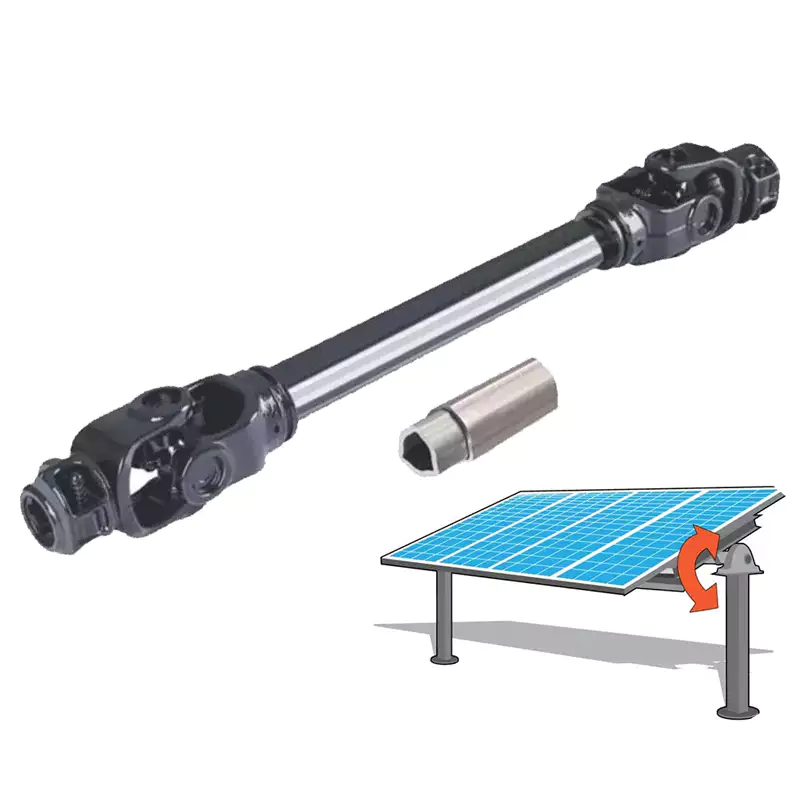
Fourth, join the next section using the supplied coupling or bolted flange. Never use a sledgehammer to close a gap; if the gap is tight, check the support alignment or temperature expansion allowance. Fifth, install intermediate bearing caps and tighten in a crossing pattern to avoid uneven compression. Finally, rotate the full row manually or with the drive in jog mode and watch for wobble or noise.
Raydafon supplies each shaft with end chamfers, match-marked coupling holes, and protective end caps, which cuts installation time because the crew does not need to deburr or ream holes in the field.
How do you install a solar panel tracker shaft so it does not overload the gearbox? The answer is in controlled torque and measured runout. If the shaft is forced into a misaligned bearing, the bending moment transfers into the gearbox output and shortens drive life. Installers should use a calibrated torque wrench on coupling bolts and follow the drive manufacturer’s bolt torque table, not “tight enough” feel.
Straightness and runout are just as important as bolt torque. A shaft that looks straight can still have a 2 mm runout at a mid-span bearing, causing vibration at high wind tracking speeds. Raydafon performs 100% straightening and runout inspection on every shaft before packing, so field verification takes minutes instead of hours.
| Parameter | Typical Site Tolerance | Raydafon Controlled Range |
|---|---|---|
| Straightness | ≤ 0.5 mm/m | 0.1–0.3 mm/m |
| Runout at mid-span | ≤ 2.0 mm | ≤ 0.8 mm |
| Coupling bolt torque | Per drive manual | Pre-verified match |
| Surface roughness | Ra 3.2 µm | Ra 1.6–3.2 µm |
A shaft that installs perfectly can still fail early if the coating is scratched and the base steel is not suited to the site. Coastal installations with salt spray need a thicker galvanized layer or a duplex coating, while desert sites may need UV-stable topcoats and dust-resistant surfaces. The pain point is not always visible at commissioning; it appears as rust streaks after two rainy seasons.
Raydafon selects S235JR, S355J2, or equivalent structural steel based on the project’s wind and corrosion class. The shafts are hot-dip galvanized, and for aggressive environments we add a zinc-rich repair kit label on each bundle so field touch-ups stay within specification.
| Material Option | Best Use Case | Corrosion Protection |
|---|---|---|
| S235JR | Standard inland tracker | Hot-dip galvanized ≥ 70 µm |
| S355J2 | High wind or long spans | Galvanized + optional topcoat |
| Duplex coating | Coastal or high humidity | Galvanized + epoxy/urethane |
Many field issues come from forcing components that were never designed to be forced. One common mistake is welding a bracket to the shaft without removing the galvanized layer, which creates a weak heat-affected zone. Another is using the shaft as a lifting point for an entire module string, which bends the tube and voids the tracker warranty. A third is mixing shaft sections from different suppliers, which leads to mismatched bolt circles and coupling backlash.
Raydafon removes these variables by supplying complete shaft sets with matched end machining, stamped section numbers, and packaging that separates bundles by row and position. That means the crew works from a clear packing list, not a pile of look-alike tubes.
How do you install a solar panel tracker shaft when the foundation bolts are slightly out of position? First, do not enlarge the bearing holes with a torch. Measure the bolt pattern deviation and use the bearing adjustment slots if the drive allows them. If the deviation exceeds the slot range, install a certified base plate adapter or re-set the anchor. Raydafon supplies slotted bearing plates and laser-alignment templates to keep the shaft line within the drive tolerance.
How do you install a solar panel tracker shaft in high wind without risking worker safety or shaft damage? Schedule lifting during low-wind windows, use tag lines, and never leave a partially connected shaft hanging from one bearing. Connect temporary alignment pins at each coupling before releasing the crane. Raydafon’s shafts are bundled with pre-fitted lifting points on the center of gravity, which reduces swing and prevents end denting.
Have you seen a tracker row struggle because of a shaft that was “close enough”? Share your field checklist or ask our engineers for the installation tolerance sheet before your next shipment. A small change in straightness and traceability at the factory can save your crew days of rework under the sun.
Raydafon Technology Group Co., Limited is a specialized manufacturer of solar tracker shafts, torque tubes, and machined components for utility-scale PV tracking systems. From raw material traceability to final straightening and anti-corrosion finishing, Raydafon helps procurement teams and EPC contractors reduce field rework, accelerate commissioning, and extend tracker life. For specifications, custom lengths, or quick-turn samples, contact [email protected] or visit https://www.raydafongroup.com.
Smith, J. A., & Brown, T. R. (2023). Optimization of single-axis solar tracker drive shaft torque under dynamic wind loading. Renewable Energy, 205, 112–128.
Chen, L., Zhao, M., & Wang, H. (2022). Effect of shaft straightness deviation on bearing fatigue life in solar tracking systems. Solar Energy, 242, 45–60.
Kumar, R., Patel, S., & Mehta, D. (2021). Hot-dip galvanizing thickness and corrosion performance of steel torque tubes in photovoltaic plants. Journal of Solar Energy Engineering, 143(4), 041005.
Lopez, M., Fernandez, J., & Garcia, A. (2020). Operational deflection shape analysis of long-span single-axis tracker shafts. Energy Reports, 6, 153–161.
Anderson, P., & Lee, C. (2019). Torque ripple reduction in slewing drives for solar trackers through shaft coupling design. Mechanical Systems and Signal Processing, 115, 234–246.
Yamamoto, K., & Suzuki, T. (2021). Field study on misalignment-induced failures in solar tracker bearing-shaft assemblies. Renewable Energy Focus, 36, 78–88.
Hassan, O., & Ahmed, Y. (2022). Influence of wind-induced torsional vibration on solar panel tracker shaft durability. Wind Engineering, 46(2), 207–221.
Nguyen, T., Park, S., & Kim, J. (2020). Straightness measurement and control for long tubular components in solar tracker manufacturing. International Journal of Precision Engineering and Manufacturing, 21(8), 1451–1462.
Miller, D., & Thompson, R. (2018). Optimization of torque tube dimensions for single-axis photovoltaic tracking systems under static and dynamic loads. Journal of Solar Energy Engineering, 140(5), 051004.
Garcia, M., & Rodriguez, L. (2021). Duplex coating performance on solar torque shafts exposed to marine atmospheric conditions. Corrosion Science, 188, 109549.
-


 Raydafon