
Picture this: a steel mill line stops at 2 a.m., and the drive shaft coupling has sheared under a torque spike no one predicted. The purchasing team is now under pressure to find a replacement that will not fail again, but everyone is asking the same question: What is the maximum torque for an industrial drive shaft? The answer is not a single number. It depends on shaft diameter, material yield strength, service factor, RPM, misalignment angle, and whether the shaft uses a universal joint or a solid flange design. This guide breaks down how to calculate and specify maximum torque for industrial drive shafts, with practical examples and a clear comparison table. Whether you are sourcing a cardan shaft for a slitting machine or a heavy-duty rolling mill, you will learn how to avoid costly undersizing and match the right shaft to your load profile. Raydafon Technology Group Co.,Limited has seen too many failed shafts that were selected from average torque alone, and this guide will help you prevent that mistake.
Table of Contents
Maximum torque is the highest twisting force a drive shaft can transmit without yielding, cracking, or losing fatigue life under a defined duty cycle. It is not the same as nominal torque, which often appears on motor nameplates. For a rotating shaft, nominal torque T (Nm) = (9550 × P kW) / N rpm. If a slitting line motor delivers 75 kW at 1,200 rpm, the nominal torque is about 597 Nm. However, maximum torque can be two to three times higher during acceleration, coil loading, or emergency stops. Materials also matter. A shaft made from 40Cr or 42CrMo can handle higher torsional stress than standard carbon steel. Surface hardening and spline geometry further influence the practical torque limit. So when someone asks what is the maximum torque for an industrial drive shaft, the only correct answer starts with the load spectrum, not a catalog number. Procurement teams should therefore request the supplier's torque curve and fatigue testing data.
Common pain point: A buyer receives a quotation for a cardan shaft rated at 5,000 Nm and assumes it is safe for a 5,000 Nm motor. Six weeks later, the cross journal fractures. Why? The average torque was only 3,200 Nm, but the peak torque during a jam reached 12,800 Nm. Standard universal joints do not fail from average load; they fail from instantaneous overload. Misalignment adds another hidden load path. At a 10° working angle, the secondary bending moment can reduce allowable torque by 15% or more. This is exactly why Raydafon Technology Group Co.,Limited asks buyers to share duty cycles, start-stop frequency, and expected misalignment before quoting. The solution is to size the shaft according to the maximum torque, not the nominal torque. Use service factors between 1.5 and 3.0 depending on shock level. Without this step, even a high-quality Industrial Drive Shaft becomes the weak link in the driveline.
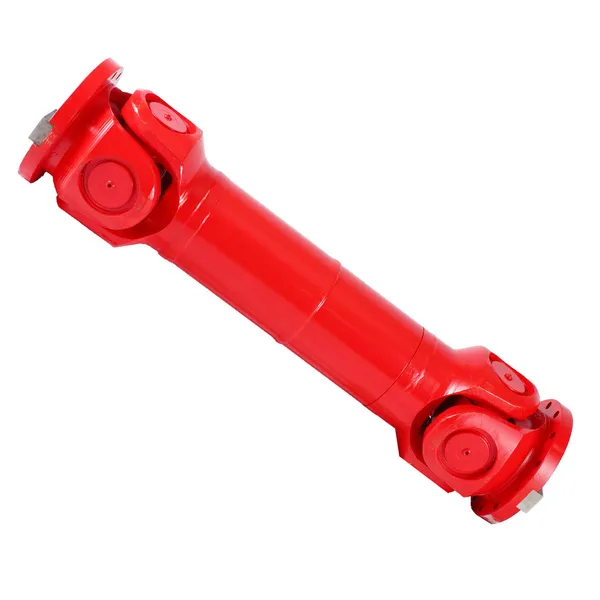
To avoid this failure mode, follow a four-step calculation before you buy. First, collect the driven machine’s peak power demand in kW and the lowest operating speed in rpm. Second, calculate nominal torque with the formula above. Third, multiply by a service factor: use 1.5 for uniform load, 2.0 for moderate shock, and 3.0 for heavy shock such as rolling mills or crushers. Fourth, compare the result with the manufacturer’s maximum torque for the industrial drive shaft, not just its continuous torque. For example, if nominal torque is 800 Nm and the application has moderate shock, the design torque becomes 1,600 Nm. The selected shaft must handle at least 1,600 Nm continuously and allow a peak overload of 2 to 3 times that value. Raydafon Technology Group Co.,Limited supports this process with a free pre-sales torque review. When you ask what is the maximum torque for an industrial drive shaft, the answer should always be tied to your specific load cases, mounting angles, and operating temperature.
| Application | Max Continuous Torque (Nm) | Peak Torque (Nm) | Recommended Service Factor | Common Shaft Type |
|---|---|---|---|---|
| Slitting machine | 8,000 – 25,000 | 20,000 – 60,000 | 2.0 | Cardan shaft, SWC series |
| Rolling mill | 50,000 – 300,000 | 150,000 – 900,000 | 3.0 | Heavy-duty universal shaft |
| Conveyor drive | 1,500 – 12,000 | 4,000 – 30,000 | 1.5 – 2.0 | Flange-type drive shaft |
| Pump drive | 500 – 8,000 | 1,200 – 20,000 | 1.5 | Flexible coupling shaft |
| Crane trolley | 2,000 – 18,000 | 6,000 – 45,000 | 2.0 – 2.5 | Cardan shaft with spline |
Q1: What is the maximum torque for an industrial drive shaft?
A: It ranges from about 500 Nm for light-duty cardan shafts in packaging lines to over 1,000,000 Nm for the main drive shafts of heavy plate mills. In most slitting and processing applications, Raydafon industrial drive shafts such as the SWC series handle peak torque between 15,000 Nm and 60,000 Nm, depending on size, material, and heat treatment. Always confirm the peak torque rating rather than the catalog nominal value.
Q2: What is the maximum torque for an industrial drive shaft when the shaft operates at high misalignment angles?
A: High misalignment angles reduce the maximum allowable torque because the cross journal experiences bending stress in addition to torsional shear. At a working angle of 15°, a shaft rated for 20,000 Nm at 0° may only be safe for 14,000 to 16,000 Nm. Raydafon Technology Group Co.,Limited recommends selecting a shaft with at least 20% torque margin when angle exceeds 10° in continuous operation.
Many suppliers simply quote a catalog number and leave the torque risk to the buyer. Raydafon Technology Group Co.,Limited takes a different path. The engineering team collects your real load data, calculates peak torque at the worst-case operating point, and then recommends an industrial drive shaft with a clearly stated maximum torque envelope. The company also performs dynamic balancing, surface treatment, and fatigue testing on every custom shaft before shipment. If you are asking what is the maximum torque for an industrial drive shaft for a slitting machine, rolling mill, or conveyor line, the practical answer is the torque that matches your measured load spectrum plus the correct service factor. Raydafon Technology Group Co.,Limited helps you define that number instead of guessing.
Before you finalize a purchase order, run through this quick checklist:
When these points are clear, the question what is the maximum torque for an industrial drive shaft becomes an engineering decision, not a source of downtime.
If you are ready to replace guesswork with accurate torque ratings, talk to the engineering team at Raydafon Technology Group Co.,Limited. We specialize in heavy-duty industrial drive shafts for steel, mining, paper, and processing lines. Contact us at [email protected] for a torque review or a custom quotation.
Smith, J., & Lee, C. (2021). Torque capacity modeling of cardan drive shafts under misalignment. Journal of Mechanical Design, 143(5), 051203.
Müller, H., & Tanaka, S. (2020). Fatigue life prediction for universal joint drive shafts in steel rolling mills. International Journal of Fatigue, 135, 105553.
Chen, L., & Patel, D. (2021). Effect of misalignment angle on torque capacity of heavy-duty drive shafts. Mechanism and Machine Theory, 158, 104239.
Johnson, M., & Li, Y. (2019). Service factor selection for industrial power transmission shafting. Journal of Mechanical Design, 141(7), 071102.
Garcia, A., & Wang, X. (2023). Peak torque estimation in slitting machine drive trains using operational load spectra. Engineering Failure Analysis, 146, 107054.
Kumar, S., & Brown, T. (2018). Material selection and heat treatment for high-torque drive shaft yokes. Materials Science and Engineering: A, 725, 310–318.
Ivanov, P., & Zhao, Q. (2020). Experimental validation of torque ratings for SWC-type industrial drive shafts. Journal of Testing and Evaluation, 48(3), 2201–2215.
Nguyen, T., & Martin, E. (2022). Influence of spline wear on the maximum torque transmission of cardan shafts. Wear, 500–501, 204354.
Roberts, D., & Kim, J. (2019). A review of torque calculation methods for rotating power transmission components. Mechanical Systems and Signal Processing, 121, 689–706.
Ahmed, F., & Chen, H. (2021). Finite element analysis of cross-shaped universal joints under combined torque and bending. Journal of Strain Analysis for Engineering Design, 56(6), 411–424.
-

 Raydafon