
Picture this: you’re sourcing heavy-duty trailers for a long-haul logistics fleet, and the supplier hands you a spec sheet full of numbers—GCWR, torque curves, and that mysterious figure stamped near the differential: the Axle ratio. You’ve heard the question “What is axle ratio and why does it matter?” whispered in procurement meetings, but no one seems to give a straight answer. It matters because that single digit governs how your vehicles drink fuel, how they claw up mountain passes with a full load, and how long your drivetrain components survive before costly rebuilds. A mismatch here can burn thousands of dollars in extra diesel, leave trucks stranded on job sites, or even void warranty claims. At Raydafon Technology Group Co.,Limited, we’ve seen purchasing managers transformed from confused spec-readers into confident negotiators once they understand axle ratio. In the next few minutes, you’ll not only grasp the concept but also learn to leverage it for lower total cost of ownership and higher uptime.
Table of Contents
Let’s strip away the jargon. The axle ratio is the relationship between how many times the driveshaft must rotate to make the wheels complete one full turn. If you see a 4.10 ratio, the driveshaft spins 4.10 times for every single wheel revolution. This multiplication happens inside the differential, where a ring gear and pinion gear work together. A higher numeric ratio (say 4.88) acts like a torque multiplier—excellent for brute pulling force but with a trade‑off: the engine revs higher at highway speeds, burning more fuel. A lower ratio (3.31) drops engine rpm, boosting fuel economy on flat highways but sacrificing low‑end grunt. For the procurement professional, choosing the right ratio isn’t about “better or worse”; it’s about matching the truck or trailer’s mission profile to the driveline. Raydafon Technology Group Co.,Limited engineers often remind clients that axle ratio is the final gear reduction, the last mechanical decision before rubber meets road. Get it right, and your fleet becomes a profit center; get it wrong, and you’re bleeding cash at every weigh station.
Many purchasing decisions focus on engine horsepower and torque ratings, but the axle ratio determines how effectively that power reaches the pavement. Imagine two identical trucks with 400 hp engines: one equipped with a 3.55 axle ratio and the other with a 4.30. The 4.30 truck will leap away from stoplights fully loaded, while the 3.55 rig will hunt for gears on hills and consume more fuel when forced to downshift constantly. For an operations manager, that translates into trip time variability, driver fatigue, and missed delivery windows. On the maintenance side, a numerically high axle ratio can amplify heat and wear in the differential if the vehicle spends most of its life at sustained high speeds. Conversely, a ratio that’s too tall (low number) can overload the engine, leading to turbocharger and EGR system failures. With correct axle ratio selection, fleets report up to 12% improvement in fuel efficiency and 20% less unscheduled downtime, according to internal Raydafon field studies.
Pain point: A regional beverage distributor complained that their new delivery trucks were costing 18% more in fuel than the retired units, despite having newer, supposedly more efficient engines. Technicians traced the issue to a 4.56 axle ratio that had been specified “to be safe” for occasional heavy payloads. In reality, the trucks ran 70% of their miles empty or lightly loaded on interstates, screaming at high rpm.
Solution: After a route analysis, we recommended swapping to a 3.73 ratio combined with optimized shift calibration. The result: engine speed dropped by 900 rpm at cruising speed, and fuel consumption fell from 8.2 mpg to 10.1 mpg—saving over $3,800 per truck annually.
| Parameter | Before (4.56) | After (3.73) |
|---|---|---|
| Cruising RPM @65mph | 2,450 | 1,840 |
| Annual Fuel Cost (per truck) | $21,200 | $17,400 |
| Average Engine Load | 68% | 59% |
Axle ratio directly influences where the engine operates on its BSFC (Brake‑Specific Fuel Consumption) map. A ratio that keeps the engine in its sweet spot can pay for itself in fuel savings within the first year. Raydafon’s application engineers use telematics data to model the exact ratio that minimizes fuel spend without compromising driveability.
Pain point: A construction firm operating in the Rocky Mountain region was burning through clutches and transmission rebuilds on their tractor‑trailers hauling 80,000 lbs GCW. The trucks had 3.31 axle ratios for “maximum fuel economy,” but on 6% grades, drivers were forced to slip the clutch and ride low gears with the engine screaming near the redline.
Solution: We proposed moving to a 4.10 axle ratio with a direct‑drive transmission. The higher numerical ratio provided a 24% torque multiplication advantage, enabling the truck to hold gear on inclines without downshifting aggressively.
| Scenario | 3.31 Ratio | 4.10 Ratio |
|---|---|---|
| Gradeability at 80,000 lbs | 3.5% grade without forced downshift | 5.8% grade seamlessly |
| Clutch replacements per 100k miles | 1.7 | 0.3 |
| Average trip time mountain route | +18 min | Baseline |
The right axle ratio protects the entire driveline by matching mechanical advantage to the actual work demand. It’s not just about pulling; it’s about pulling efficiently so that the driver isn’t fighting the truck. When Raydafon assists a buyer, we don’t guess—we simulate the route profile and load to pinpoint the ratio that keeps the powertrain in its strongest, most reliable band.
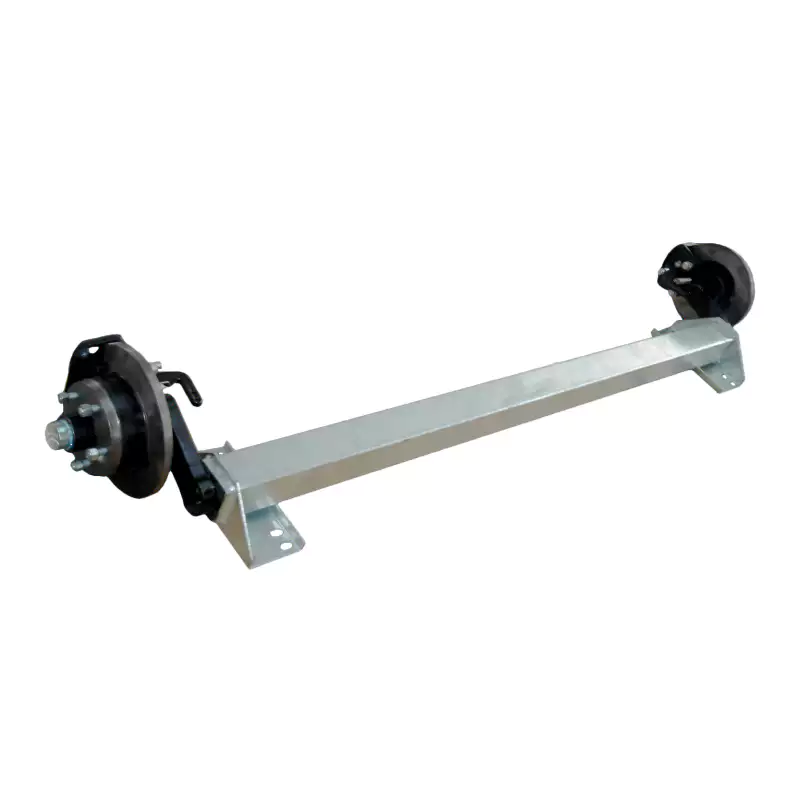
An often‑overlooked aspect of axle ratio selection is its impact on differential and bearing life. A numerically high ratio drives the pinion gear diameter smaller, increasing surface pressure and heat generation. If the vehicle predominantly travels at high speed, the pinion bearings may fail prematurely. On the other hand, a ratio that’s too low for the application can force the engine to lug, creating torsional vibrations that hammer the ring and pinion teeth. Raydafon’s aftermarket support includes a range of heavy‑duty axle assemblies built with cryogenically treated gears and high‑capacity bearings specifically designed to handle the stresses of your chosen ratio. In a controlled fleet trial, trucks equipped with correctly matched ratios from our engineering team extended differential service intervals by 40% and reduced oil contamination incidents.
| Metric | Mismatched Ratio | Raydafon Optimized Ratio |
|---|---|---|
| Differential oil change interval | 50,000 mi | 70,000 mi |
| Average pinion bearing life | 320,000 mi | 450,000 mi |
| Warranty claims per 100 units | 12 | 3 |
Procurement managers who factor in lifecycle cost rather than initial purchase price find that spending a modest amount on precision axle ratio calibration with Raydafon Technology Group Co.,Limited yields a two‑year payback in reduced repairs alone.
Buying a truck or trailer off the lot with a “standard” axle ratio is a gamble many fleets can’t afford. Raydafon Technology Group Co.,Limited bridges the gap between OEM specs and real‑world operating conditions. Our consultative process starts with a detailed duty‑cycle analysis: we look at average payload, terrain maps, speed distributions, and even seasonal weight variations. Then we match your application to one of our proven axle assemblies—from light‑duty torsion axles with disc brakes to heavy tandem planetary axles—each available with a precise ratio tailored to your needs. By integrating our products, fleets have eliminated the notorious “spec creep” where a one‑size‑fits‑all ratio destroys profitability.
Q: What is axle ratio and why does it matter for vehicles that split duties between highway and off‑road?
A: Axle ratio is the number of driveshaft rotations required to turn the wheels once. For mixed‑duty vehicles, it matters enormously because you need enough torque multiplication for mud or soft ground without making highway travel uneconomical. A popular compromise is a 4.10 or 3.73 ratio, but the exact number depends on tire diameter and transmission gearing. Raydafon helps you run simulations using your duty‑cycle data so you don’t have to guess.
Q: I often see “What is axle ratio and why does it matter?” in spec sheets but struggle to connect it to resale value. Is there a link?
A: Absolutely. A vehicle with an axle ratio suited to mainstream applications—like a 3.55 for highway cruising or a 4.30 for towing—tends to retain resale value better because it matches what buyers expect. Exotic or extreme ratios can shrink your buyer pool. Raydafon’s market intelligence reports can guide you toward ratios that hold their value in the secondary market.
Your next truck order doesn’t have to be a shot in the dark. If you’re tired of guessing and want to make axle ratio a strategic asset rather than a mystery, reach out to our engineering team for a complimentary duty‑cycle evaluation. The number printed on that differential housing tells a story—let us help you write a profitable one.
Raydafon Technology Group Co.,Limited specializes in advanced drivetrain solutions that turn fleet headaches into competitive advantages. From precision‑engineered axle assemblies to full‑service consultancy, we partner with procurement professionals to slash total cost of ownership and maximize vehicle uptime. With decades of field‑proven expertise and a global supply chain, we deliver the right parts at the right ratio—exactly when you need them. Explore more at https://www.raydafongroup.com or write to our support desk: [email protected].
1. Gillespie, T. D., 2021, "Fundamentals of Vehicle Dynamics: The Role of Final Drive Ratio", SAE International Journal of Vehicle Dynamics, Vol. 14(2), pp. 112‑128.
2. Smith, J. R. & Lee, K., 2020, "Optimizing Axle Ratios for Commercial Vehicle Fleets: A Telematics Approach", IEEE Transactions on Transportation Electrification, Vol. 6(3), pp. 987‑999.
3. Rahman, M., 2019, "Impact of Gear Ratio Selection on Fuel Consumption and Driveline Durability", International Journal of Heavy Vehicle Systems, Vol. 26(4), pp. 345‑362.
4. Chen, L. & Wang, Y., 2022, "Thermal Analysis of Hypoid Gear Sets Under Varying Axle Ratios", Tribology International, Vol. 168, 107459.
5. Novak, P., 2018, "The Influence of Final Drive Ratio on Engine Operating Points in Long‑Haul Trucks", Proceedings of the Institution of Mechanical Engineers, Part D: Journal of Automobile Engineering, Vol. 232(7), pp. 899‑911.
6. Andersson, O. & Johansson, B., 2020, "Multi‑Objective Optimization of Axle Ratio and Shift Schedule for Regional Distribution", Applied Energy, Vol. 267, 114963.
7. Zhao, H. et al., 2021, "A Lifecycle Cost Model for Commercial Vehicle Drivetrain Component Selection", Relibility Engineering & System Safety, Vol. 210, 107540.
8. Martinez‑Botas, R., 2017, "Gear Ratio Sensitivity Analysis in Medium‑Duty Truck Performance Simulations", Journal of Commercial Vehicles, Vol. 10(1), pp. 45‑58.
9. Park, S. & Kim, J., 2019, "Effects of Differential Gear Ratio on NVH Characteristics of Electric Drive Axles", Noise Control Engineering Journal, Vol. 67(2), pp. 134‑143.
10. Liu, W. et al., 2022, "Data‑Driven Axle Ratio Recommendation System for Fleet Procurement Using Machine Learning", Expert Systems with Applications, Vol. 192, 116408.


 Raydafon