
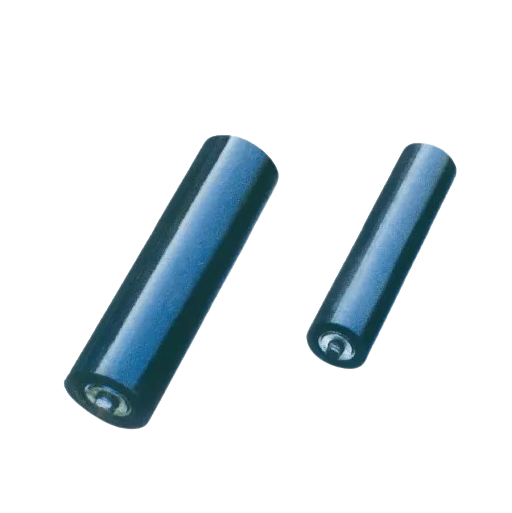
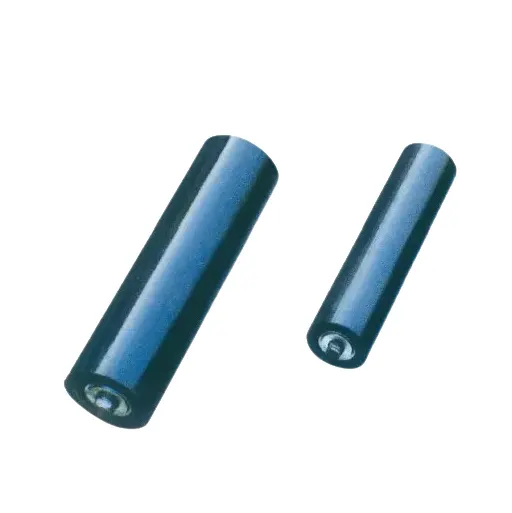
The TD75 Belt Conveyor Impact Roller is a tough, specialized component in the TD75 conveyor system, a standard setup from 1975 used in mining, ports, and other heavy-duty industries. These rollers are placed at loading points where materials like coal, ore, or gravel hit the conveyor belt hard, absorbing the shock to protect the belt and keep things running smoothly.
Built to handle rough conditions, they cut down on belt damage, reduce maintenance, and help your conveyor last longer. This page lays out what these impact rollers do, where they’re used, how to install them, what customers think, and answers to common questions, all in simple language to help you see if they fit your needs.
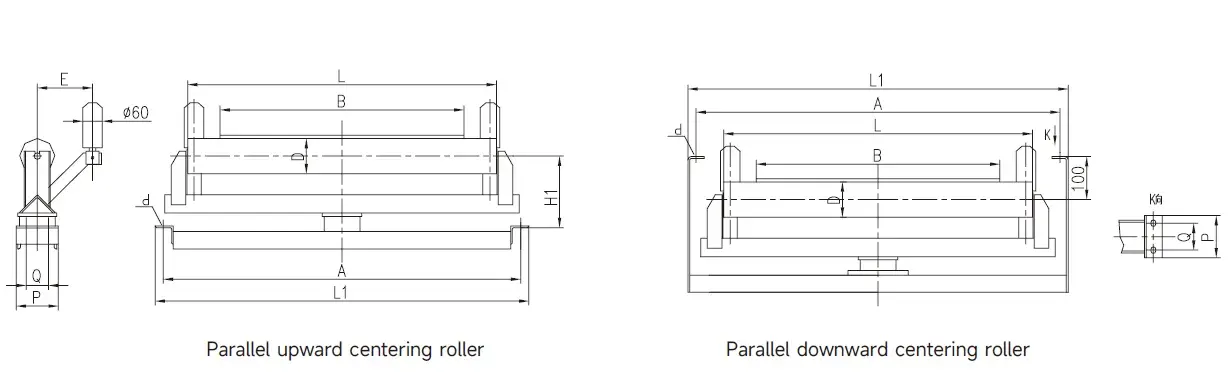 Unit: mm
| 500 | 190 | 200 | 220 | Ø89 | Ø20 | 14 | 4G204 |
| 600 | 610 | 640 | |||||
| 650 | 240 | 250 | 270 | ||||
| 750 | 760 | 790 | |||||
| 800 | 305 | 315 | 335 | ||||
| 950 | 960 | 990 | |||||
| 1000 | 375 | 385 | 408 | Ø108 | Ø25 | 18 | 4G305 |
| 1150 | 1160 | 1200 | |||||
| 1200 | 455 | 465 | 488 | ||||
| 1400 | 1410 | 1450 | |||||
| 1400 | 525 | 535 | 558 | ||||
| 1600 | 1610 | 1650 |
The TD75 Impact Roller is designed to take the brunt of heavy material drops while keeping your conveyor belt in good shape. Here’s what it offers:
Shock-Absorbing Design
Covered with rubber or composite rings (8mm-20mm thick) to cushion the impact of falling materials.
Reduces belt damage and wear at loading points like chutes or hoppers.
Strong Materials
Roller tube made from Q235 steel (similar to SS400 or ASTM A36) for durability under heavy loads.
Shafts use 45# steel (like DIN C45 or ASTM A1045), hardened to resist wear.
Reliable Bearings
Deep groove ball bearings with C3 clearance and 2RZ/2Z seals for smooth operation and long life.
Triple labyrinth seals keep out dust, dirt, and water, perfect for messy mining sites.
Low Noise and Vibration
Precision manufacturing and balance testing ensure quiet, smooth performance.
Minimizes stress on the belt and conveyor frame, extending their lifespan.
Corrosion Resistance
Options for baking paint, zinc plating, or epoxy coatings to fight rust, especially in places like coastal ports.
High-polymer or rubber rings add extra protection and are flame-retardant for safety.
Customizable Sizes
Diameters from 76mm to 219mm, lengths from 100mm to 3000mm, fitting belts 500mm to 2400mm wide.
Can be tailored with different ring thicknesses or bracket designs for specific setups.
Meets Industry Standards
Built to TD75, DTII, CEMA (B, C, D, E), and ISO 9001 standards for quality and safety.
Tested for runout, balance, and impact resistance to ensure reliability.
Installing TD75 Impact Rollers is simple if you follow these steps:
Check Specs
Confirm the roller’s diameter, length, and ring thickness match your conveyor’s needs.
Ensure the conveyor frame is aligned and strong enough to hold the rollers.
Place the Rollers
Install impact rollers under loading points, like chutes or hoppers, where materials drop onto the belt.
Space them 0.5-1m apart, depending on the load and belt width.
Align Properly
Set rollers perpendicular to the belt to ensure even shock absorption.
Check that the frame supports the rollers securely to handle heavy impacts.
Inspect Bearings and Seals
Verify bearings are greased with lithium soap grease, and triple labyrinth seals are intact.
Don’t tamper with seals—they keep out dirt and water.
Adjust Belt Tension
Set tension to keep the belt snug without overloading the rollers. Use:[ T = \frac{P_p \cdot 1000}{v} ] where (T) is tension (Newtons), (P_p) is power (kilowatts), and (v) is belt speed (meters/second).
Test the Setup
Run the conveyor at low speed with a small load to check roller performance.
Adjust alignment or spacing if the belt shows signs of wear or uneven movement.
Use trained workers to follow safety standards.
Keep a log of setup details for future maintenance.
Contact us for help with installation.
Regular upkeep keeps TD75 Impact Rollers working well:
Check Regularly: Inspect rollers, bearings, and rubber rings every 3-6 months for wear or damage.
Grease Bearings: Use lithium soap grease to keep bearings spinning smoothly.
Clean the Belt: Use scrapers to prevent material buildup on rollers.
Inspect Rings: Check rubber or composite rings for cracks and replace if needed.
Use OEM Parts: Stick to TD75-compliant parts for repairs.
| Roller type | Speed (m/s) | Belt width(mm) | Roller type | Speed (m/s) | Belt width(mm) | ||||||||||
| 500 | 650 | 800 | 1000 | 1200 | 1400 | 500 | 650 | 800 | 1000 | 1200 | 1400 | ||||
| Capacity Q(t/h) | Capacity Q(t/h) | ||||||||||||||
| Trough roller | 0.8 | 78 | 131 | ― | ― | ― | ― | Parallel roller | 0.8 | 41 | 67 | 118 | ― | ― | ― |
| 1 | 97 | 164 | 278 | 435 | 655 | 891 | 1 | 52 | 88 | 147 | 230 | 345 | 469 | ||
| 1.25 | 122 | 206 | 348 | 544 | 819 | 1115 | 1.25 | 66 | 110 | 184 | 288 | 432 | 588 | ||
| 1.6 | 156 | 264 | 445 | 696 | 1048 | 1427 | 1.6 | 84 | 142 | 236 | 368 | 553 | 753 | ||
| 2 | 191 | 323 | 546 | 853 | 1284 | 1748 | 2 | 103 | 174 | 289 | 451 | 677 | 922 | ||
| 2.5 | 232 | 391 | 661 | 1033 | 1556 | 2118 | 2.5 | 125 | 211 | 350 | 546 | 821 | 1117 | ||
| 3.15 | ― | ― | 824 | 1233 | 1858 | 2528 | 3.15 | ― | ― | ― | ― | ― | ― | ||
| 4 | ― | ― | ― | ― | 2202 | 2996 | 4 | ― | ― | ― | ― | ― | ― |
Here’s what users of TD75 Impact Rollers are saying:
Shanxi Coal Mining Co., China
“These impact rollers from Raydafon save our belts from heavy coal drops. Maintenance is way down, and they’re super reliable.” – Zhang Wei, Operations Manager
Australian Gold Mine
“The rollers take a beating at our loading zones and keep going. They’ve saved us a ton on belt replacements.” – Sarah Thompson, Site Engineer
South African Port Terminal
“These rust-resistant rollers work great by the coast. We hardly need to maintain them.” – Thabo Nkosi, Logistics Manager
Chilean Copper Mine
“Our conveyor’s uptime is up 15% thanks to these impact rollers. They’re tough and easy to work with.” – Juan Morales, Maintenance Supervisor
These comments show Raydafon makes rollers that customers can count on.
Got questions? Here are clear answers with keywords to help you find us:
1. What’s a TD75 Impact Roller?
A roller with rubber rings that absorbs shock at conveyor loading points, protecting the belt in mining or similar industries.
2. How does it protect the belt?
Rubber or composite rings cushion the impact of heavy materials, reducing tears and stretching.
3. What’s it made of?
Q235 steel for the tube, 45# steel for the shaft, with rubber or composite rings and optional rust-proof coatings.
4. How often should I maintain it?
Check every 3-6 months, grease bearings, clean buildup, and inspect rings. Don’t touch the seals.
5. Can it be customized?
Yes, we offer different sizes, ring thicknesses, and coatings.
6. Where’s it used?
Mining, metallurgy, ports, construction, and power plants for handling bulk materials.
Address
Luotuo Industrial Area, Zhenhai District, Ningbo City, China
Tel

 Raydafon