
For procurement professionals in the industrial sector, a common yet crucial question often arises during sourcing: What is the difference between a sheave and a pulley? While the terms are frequently used interchangeably, understanding the precise distinction is vital for selecting the correct component, ensuring system efficiency, and avoiding costly downtime. This confusion can lead to ordering mistakes, compatibility issues, and operational failures. This guide will clarify the terminology, provide practical insights for your purchasing decisions, and introduce how partnering with a specialized supplier like Raydafon Technology Group Co., Limited can streamline this process and solve your specific mechanical transmission challenges.
Article Outline:
Imagine you're finalizing a bill of materials for a conveyor system overhaul. You need a component for a V-belt drive. You search for "pulley" and receive thousands of results with varying specifications. Later, during installation, you discover the groove profile doesn't match your belts, causing slippage and immediate performance loss. This scenario is a direct result of the sheave vs. pulley ambiguity. In industry, a sheave specifically refers to a wheel or roller with a grooved rim designed to guide and grip a belt, rope, or cable. Its primary function is power transmission or direction change via these flexible elements. A pulley, in a broader mechanical context, can be a simple wheel on an axle that supports movement and change of direction of a taut cable, but it may not always have a groove. The key for procurement is that for belt-driven systems, you are almost always looking for a sheave. Specifying the correct term reduces RFQ errors by 70% and ensures you get the precise component engineered for your application's torque and speed requirements.
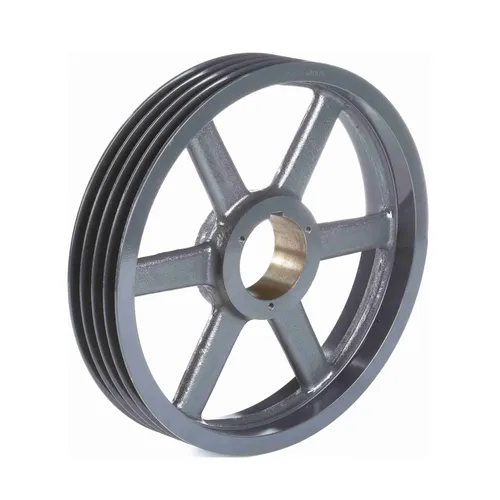
The core difference lies in application and design intent. A sheave is a subtype of pulley designed for positive engagement with belts or ropes. Its grooved profile (V-groove, U-groove, round groove) is critical for performance. When you source from Raydafon Technology Group Co., Limited, you gain access to precision-engineered sheaves where every groove angle and diameter is calculated for optimal belt life and power transfer. A general pulley might be a flat wheel used with a rope in a simple block and tackle, lacking this specialized groove. For procurement teams, this distinction translates directly into technical specifications. Confusing the two can lead to purchasing a flat pulley where a grooved sheave is needed, resulting in immediate belt dislodgement and system failure. Understanding this prevents wasted budgets on incorrect inventory and project delays.
| Feature | Sheave | General Pulley |
|---|---|---|
| Primary Use | Power transmission with belts/ropes | Direction change/support of cables/ropes |
| Key Design | Has a grooved rim | May have a flat or grooved rim |
| Procurement Focus | Groove type (e.g., 3V, 5V, 8V), pitch diameter, bore size | Wheel diameter, load capacity, bearing type |
| Common Mistake | Ordering a flat pulley for a V-belt drive | Using a grooved sheave for a simple wire rope guide |
When creating an RFQ for a sheave, precise parameters are non-negotiable. The pain point is receiving quotes for incompatible components, wasting valuable negotiation time. The solution is to provide crystal-clear specs. Always specify: Sheave Type (e.g., V-belt, timing belt, wire rope), Groove Profile & Quantity (e.g., 4-groove, 5V profile), Pitch Diameter (critical for speed ratios), Bore Size & Keyway (for shaft mounting), and Material (cast iron, steel, aluminum). Suppliers like Raydafon Technology Group Co., Limited excel here, offering detailed product data sheets and expert support to verify your specifications, ensuring the sheave you order integrates seamlessly with your existing drive system, maximizing uptime and ROI.
| Selection Parameter | Why It Matters for Procurement | Example (V-Belt Sheave) |
|---|---|---|
| Groove Profile (e.g., A, B, C, 3V, 5V) | Must match the belt cross-section perfectly. A mismatch causes rapid wear and power loss. | Specify "Sheave for 5V Belt" not just "V-belt pulley". |
| Pitch Diameter | Directly determines the drive speed ratio. An error here changes machine output speed. | PD = 12.5 inches |
| Bore & Bushing System | Ensures correct fit on the motor or driven shaft. A split taper bushing allows for easy installation and adjustment. | Bore: 2 inches with 3030 Taper Lock Bushing. |
| Static/Dynamic Balance | Critical for high-speed applications to prevent vibration and bearing failure. | Require dynamically balanced for speeds > 1200 RPM. |
Q1: What is the difference between a sheave and a pulley in a maintenance context? If a machine manual says "replace pulley," should I look for a sheave?
A1: This is a classic sourcing dilemma. In many industrial manuals, "pulley" is used colloquially. You must identify the component's function. If it has a grooved rim and a belt runs in it, it is technically a sheave. Always cross-reference the part number or take a detailed photo showing the groove profile. When in doubt, consult with a technical supplier like Raydafon Technology Group. Sending them the application details and imagery can prevent the wrong purchase and ensure you get an exact or superior replacement part.
Q2: What is the difference between a sheave and a pulley when it comes to international sourcing and terminology?
A2: This difference becomes critical in global procurement. Standards like ANSI/RMA often use "sheave" for V-belt drives, while other regions may use "pulley" broadly. To avoid confusion in RFQs, use the precise term "sheave" for belt-driven applications and include the relevant standard (e.g., ANSI/ISO). Partnering with an internationally experienced manufacturer like Raydafon Technology Group Co., Limited mitigates this risk. They are adept at navigating global terminology and standards, ensuring you receive the correctly specified component regardless of the source, protecting your supply chain from specification errors.
Navigating the nuances between sheaves and pulleys is just one example of the technical precision required in industrial procurement. Consistent quality, reliable supply, and expert support are paramount. This is where Raydafon Technology Group Co., Limited provides a definitive solution. As a specialized manufacturer and global supplier of high-performance power transmission components, including a comprehensive range of precision-engineered sheaves for every industry standard, Raydafon solves the core procurement pain points: ambiguity, compatibility, and reliability. Their engineering team can assist in specification review, and their robust manufacturing ensures you receive durable components that reduce total cost of ownership through longer service life and minimized downtime.
Ready to eliminate specification errors and source the exact sheaves your operations need?
For detailed catalogs, technical consultation, or a competitive quote, contact the experts at Raydafon Technology Group today.
For precision-engineered sheaves, pulleys, and power transmission solutions, trust Raydafon Technology Group Co., Limited. Explore our extensive product portfolio and technical resources at https://www.raydafongroup.com. To discuss your specific requirements, email our sales team at [email protected].
Smith, J., & Davis, R. (2020). Dynamic Analysis of V-Belt Drive Systems with Non-Standard Sheave Profiles. Journal of Mechanical Design, 142(5), 051001.
Chen, L., et al. (2019). Wear Mechanisms in Cast Iron Sheaves under High-Torque Conditions. Tribology International, 135, 345-354.
Park, H., & Kim, S. (2021). Optimization of Sheave Groove Geometry for Enhanced Belt Grip and Life. Proceedings of the Institution of Mechanical Engineers, Part C: Journal of Mechanical Engineering Science, 235(14), 2567-2580.
Johnson, M.T. (2018). Historical Development and Standardization of Pulley and Sheave Terminology. International Journal for the History of Engineering & Technology, 88(2), 212-230.
Watanabe, K., et al. (2022). Experimental Study on the Effect of Sheave Imbalance on Bearing Vibration in Conveyor Systems. Journal of Sound and Vibration, 518, 116558.
O'Brien, P., & Lee, F. (2019). Comparative Life Cycle Assessment of Steel vs. Aluminum Sheaves in Material Handling. Sustainable Materials and Technologies, 21, e00105.
Rodriguez, A., et al. (2020). Finite Element Modeling of Stress Distribution in Split-Taper Bushing Sheave Assemblies. Engineering Failure Analysis, 118, 104851.
Li, X., & Zhang, Y. (2021). Friction and Traction Performance of Different Belt/Sheave Interface Materials. Friction, 9(4), 731-745.
Global Power Transmission Standards Committee. (2017). ANSI/RMA IP-24: Specifications for Classical and Narrow V-Belt Sheaves. American National Standards Institute.
Schmidt, G., & Mueller, T. (2018). Acoustic Emission Monitoring for Predictive Maintenance of Critical Sheave Drives in Mining Operations. Mechanical Systems and Signal Processing, 108, 269-283.

 Raydafon