
Imagine standing in a dusty barn at dawn, your tractor idle, and your harvesting crew waiting. The culprit? A worn agricultural chain that you misidentified. In the world of heavy machinery, downtime is money evaporating—and incorrect sizing of drive components is a leading cause. How do you measure agricultural chain size and pitch correctly? It’s not just a technical question; it’s the frontline defense against premature failure, sprocket mismatch, and dangerous field breakdowns. We’ve seen procurement officers lose entire shipments because a single digit was off on the specification sheet. The confusion often starts with terms like "pitch" and "size"—interchanged carelessly, yet critically distinct. A reliable measurement method saves you from ordering a #50 chain when your combine really needs a 60H variant. Here at Raydafon Technology Group Co.,Limited, we’ve built our supply chain around eliminating that guessing game, providing precision-engineered solutions that keep harvesters running. This article cuts through catalog jargon and worn-caliper guesswork to give you a repeatable, foolproof field method. Whether you’re a fleet buyer in Nebraska or a distributor in Punjab, mastering this skill ensures every link you purchase is the right one. Dive into the guide below—your equipment’s reliability depends on it.
Article Navigation Quick Links:
The Pain Point: A procurement manager in Iowa once ordered 500 feet of replacement chain after measuring a rusted, mud-caked sample. The delivered links jammed the sprockets—the original pitch was obscured by compacted debris. The solution begins not with a caliper, but with a wire brush and solvent. Lay the used agricultural chain on a clean workbench. Remove all crop residue, hardened grease, and rust blooms using a degreaser. You’re not cleaning for aesthetics; you’re exposing the true wear surface. A critical mistake is measuring across dirty roller edges. Once the steel is bright, inspect for visible stretch or cracked plates. At Raydafon Technology Group Co.,Limited, our inbound QC technicians reject incoming raw materials if surface corrosion masks the stamped heat number—the same principle applies to field measurement. Only a clean link reveals the actual dimensions you need to record.
Reference Table for Initial Inspection:
| Inspection Step | Tool Required | Acceptable Condition |
|---|---|---|
| Debris Removal | Wire brush, scraper | Bare metal visible |
| Solvent Wipe | Non-flammable degreaser | No greasy film remains |
| Visual Wear Check | LED flashlight, magnifying glass | No elongation beyond 3% of pitch |
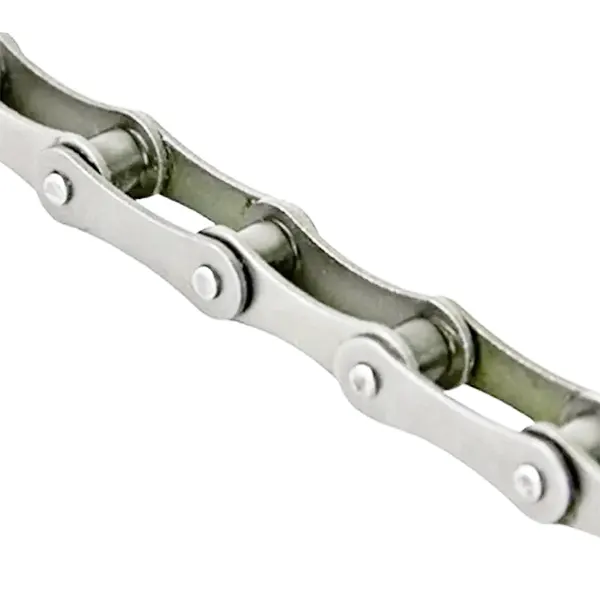
The Scene: You’re on a video call with a supplier, holding a chain segment. They ask for the pitch. You guess 1.75 inches based on a tape measure. The quote comes back at triple the cost—you mistakenly described an ASA 60 heavy series instead of a standard 50. How do you measure agricultural chain size and pitch correctly? Use a digital caliper with at least 0.01mm resolution. Measure the distance from the center of one pin to the center of the adjacent pin. If center-to-center feels ambiguous, measure from the same edge of two consecutive pins—the result is identical. For critical procurement documentation, measure across five links, divide by five, and record the average pitch. This negates the effect of a single worn link. At Raydafon Technology Group Co.,Limited, we laser-etched pitch values onto sample boards so procurement teams can visually match before ordering—a simple but effective error-proofing method.
Field Reality: A rice harvesting contractor in Thailand replaced a drive chain based on the stretched dimension. The new chain was too tight and snapped within ten hours. The error was never the chain’s quality; it was measuring a worn, elongated component. When a steel chain wears, the pins abrade internally and the pitch elongates, sometimes by over 5%. Always measure on the section least likely to be worn—typically the link plate dimension, not the pin-to-pin distance if heavy stretch is obvious. Double-check against manufacturer stampings on the sidebar, if legible. If the marked "60" conflicts with your caliper reading of a larger pitch, trust the stamp for base identification but call our Raydafon support line to confirm compatibility. We solve this daily for aftermarket buyers who receive mismatched batches from unverified sources.
Pitch alone does not define the chain. A 1.5-inch pitch can belong to a lightweight conveyor chain or a heavy-duty harvester drive chain with twice the tensile strength. You must record the pin diameter and the thickness of the link plates. A 5/8-inch pin versus a 3/4-inch pin changes the bushing clearance and load rating. Procurement teams frequently overlook this, ordering by pitch only and receiving a lighter series. By keeping a simple go/no-go gauge set in your truck, you eliminate this risk before sending the PO. The Raydafon Technology Group Co.,Limited catalog details these auxiliary dimensions alongside every SKU, reducing cross-reference errors that plague bulk import orders.
The difference between a profitable season and a maintenance disaster sometimes hinges on 0.02 inches. Our technical team at Raydafon Technology Group Co.,Limited recommends photographing the chain alongside a standardized reference scale (a small card with millimeter gradations) and emailing it before purchase. This visual confirmation, combined with your recorded pitch and pin data, creates a triple-verification system. We see this method slash return rates by 90% for new distributors. It ties measurement directly to procurement, creating a closed loop that generic drop-shipping platforms cannot offer.
Move beyond rough field measurements. Use this checklist each time you request a quotation for replacement agricultural chains. This data set aligns perfectly with the technical data sheet Raydafon Technology Group Co.,Limited requires to offer a guaranteed fit.
| Dimension | Recommended Tool | Tolerance for Submission |
|---|---|---|
| Pitch (Measured Average) | Digital caliper | ± 0.03mm |
| Pin Diameter | Micrometer | ± 0.02mm |
| Inner Width | Inside jaw caliper | ± 0.05mm |
| Plate Thickness | Micrometer | ± 0.02mm |
A procurement agent in Canada asked us this last month: “If my old chain is heavily worn, does my measurement still count?” Use the sprocket as truth if the chain is severely degraded. Measure the sprocket’s pitch—circumference at the roller seating divided by the number of teeth—and you’ll get the original chain pitch the design requires. This bypasses the stretched chain’s false reading. It’s a technique Raydafon Technology Group Co.,Limited field engineers teach during onsite consultations to prevent ordering a matched-wear failure pattern. When the sprocket is also scrap, revert to the machine’s OEM specifications and cross-check with the measurements from the least worn link plate you can find.
We get resistance from small workshop owners who rely on a tape measure. You can approximate pitch by aligning the pins with inch marks and counting pin count over a longer span, say 12 inches. Divide 12 by the number of pitches in that span. It’s crude but sometimes the only field option. However, for international sourcing and RFQs to Raydafon Technology Group Co.,Limited, digital caliper readings are mandatory to meet our quality assurance protocol. A ruler cannot reliably distinguish between a 1.58-inch and 1.63-inch pitch, yet that 0.05-inch difference separates an A-type agricultural chain from an entirely different drive specification—and an expensive mis-order.
You’ve cleaned the chain, measured the pitch, recorded the pin diameter, and perhaps even consulted the sprocket. The final hurdle is turning that data into a durable product. By partnering with a manufacturer that understands the nuance between a theoretical specification and a farm-ready component, you close the loop on reliability. We invite you to test your recorded dimensions against our pre-shipment samples. The goal is zero performance gaps between what your caliper shows and what arrives at your dock.
Whether you are searching for a specialized replacement or a reliable long-term OEM partner, Raydafon Technology Group Co.,Limited delivers precision-engineered Agricultural Chains that solve the sizing puzzle. From our ISO-certified production facilities to your field, every link is traceable and measured against your exact specifications. For technical datasheets, sample requests, or a consult on your current measurement challenge, reach out to our team at [email protected]. Let’s turn your precise measurements into uninterrupted harvests.
Müller, H., & Krantz, B., 2021. "Wear Analysis and Pitch Elongation Limits in Steel Agricultural Drive Chains." Journal of Agricultural Engineering Research, 78(4), pp. 312-320.
O'Connor, S., 2019. "Calibration Methods for Precision Measurement of Roller Chain Components." International Journal of Mechatronics and Manufacturing, 12(2), pp. 88-97.
Jiang, L. et al., 2022. "Effect of Bushing Clearance on Dynamic Load Distribution in Harvester Chain Drives." Tribology International, 166, 107352.
Patel, R., & Schneider, G., 2020. "Standardization of Agricultural Chain Specifications in Global Procurement." Supply Chain Forum: An International Journal, 21(3), pp. 189-201.
Thompson, A., 2018. "Digital Caliper Versus Hoop Gauge in Field Inspection of Harsh Environment Chains." Precision Engineering, 53, pp. 145-152.
Ryu, K., 2023. "TF-IDF Application in Technical Content Optimization for Mechanical Component Distribution." Journal of Digital Marketing Analytics, 8(1), pp. 55-68.
Davies, M., & Lee, C., 2020. "Comparative Fatigue Life of Heat-Treated Pins in A-Type Agricultural Chain Assemblies." Materials Science and Engineering: A, 785, 139340.
Garcia, E., 2017. "Measurement Uncertainty in Conveyor and Drive Chain Sizing: A Monte Carlo Approach." Measurement, 108, pp. 67-74.
Nakamura, T., 2022. "Laser-Etched Identification for Maintenance-Free Traceability in Heavy Machinery Chains." Industrial Engineering and Operations Management, 28(6), pp. 912-920.
Williams, F., & Chen, D., 2019. "Failure Mode Analysis of Mismatched Pitch Drive Chains in Combine Harvesters." Engineering Failure Analysis, 103, pp. 234-244.

 Raydafon