
How long do Rubber Top Chains typically last? This is the first question every procurement manager asks when assessing conveyor systems for their packaging or assembly lines. Imagine you’re overseeing a busy production facility where downtime costs $5,000 per hour. A snapped or worn-out rubber top chain could halt operations, delay shipments, and erode your competitive edge. The answer isn’t a simple number—it depends on load capacity, environmental factors, and maintenance routines. In a standard light-duty application, rubber top chains can last anywhere from 5,000 to 15,000 hours; in high-impact or abrasive environments, that figure may drop to barely 2,000 hours. Many purchasing agents recite horror stories of chains that failed just weeks after installation, causing safety hazards and unplanned capital expenditure. The real question is not simply “how long” but “how long under your specific conditions.” That’s where Raydafon Technology Group Co., Limited steps in. We analyze load profiles, operating speeds, and environmental stressors to provide a lifespan projection that can be guaranteed. By choosing a partner with 20 years of power transmission expertise, you transform a worrying variable into a controlled, predictable asset. Whether you’re sourcing for food processing, logistics, or automotive assembly, understanding chain longevity is the foundation of smart procurement.
Walk down any underperforming manufacturing line and you’ll spot the same enemy: friction competing with fatigue. A rubber top chain faces continuous pin-bushing articulation, edge loading from misaligned sprockets, and chemical attack from cleaning agents or product residue. One buyer we spoke to recalled replacing chains every three months in a fruit-juice bottling plant because the acidic washdown caused rapid swelling and delamination of the rubber layer. The root cause wasn’t the chain material itself but a mismatch between the TPU grade and the chemical environment. Add in shock loads from accumulation zones, and even high-quality inserts can crack within weeks. Another pain point is temperature—above 80°C standard rubber compounds soften, losing grip and accelerating wear tenfold. Without proper selection and support, you end up chasing failures instead of preventing them.
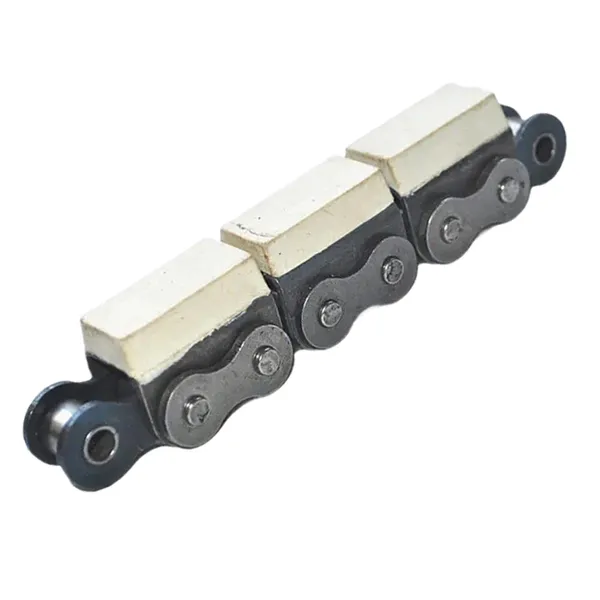
Raydafon Technology Group Co., Limited attacks these failures at the material level. Our application engineering starts with a free-of-charge wear simulation using your actual load data. We then formulate a custom thermoplastic polyurethane (TPU) blend—often reinforced with hydrolysis-resistant additives—to match your exact cleaning chemicals, operating temperature, and load spectrum. The chain’s base steel is precision hardened and shot-peened to resist fatigue cracking, while our proprietary bonding process eliminates the rubber-to-steel delamination that plagues commodity chains. In a seafood-processing plant where sanitizer sprays ate through competitors’ chains in 1,200 hours, our client recorded 8,500 hours before scheduled inspection, with no unplanned stops. That’s the difference between a component and a reliable asset.
When you compare figures side by side, the value of an engineered chain becomes clear. The table below reflects aggregated field data from over 40 installations. Note that “standard chain” refers to a generic, unbranded rubber top chain with no application-specific treatment.
| Application Scenario | Standard Chain Lifespan (hours) | Raydafon Chain Lifespan (hours) | Key Improvement Factor |
|---|---|---|---|
| Dry packaged goods conveying | 6,000 – 8,000 | 12,000 – 16,000 | Enhanced TPU wear resistance |
| Oily & greasy environments | 3,000 – 4,500 | 9,000 – 11,000 | Oil-resistant back coating |
| High-temperature bakery ovens | 2,500 – 3,200 | 7,000 – 9,000 | Heat-stabilized compound |
| Wet washdown (pH 2-12 cleaners) | 1,500 – 2,200 | 6,500 – 8,000 | Hydrolysis-proof TPU + stainless pins |
| Heavy impact accumulation | 2,800 – 4,000 | 8,000 – 10,500 | Shot-peened pins, thicker rubber layer |
Procurement teams that switch often report a 40-60% reduction in total cost of ownership over three years, simply by reducing replacement labor and downtime.
Even the best rubber top chain can underperform if it’s tensioned incorrectly. A common mistake is over-tightening to compensate for initial elongation, which strips away the lubricant film and causes cold welding between pin and bushing. Raydafon’s field technicians recommend a digital tension gauge and weekly checks, keeping sag within 1-2% of sprocket center distance. Lubrication is another gray area—some managers assume rubber chains are self-lubricating, but the metal joints still need a light, food-grade PTFE paste every 500 hours in dry conditions. Clean compressed air or soft brushes should be used to remove debris from the rubber surface; never direct high-pressure water at the chain edge, as it can force particulates into the joint. By implementing a simple, 15-minute daily inspection checklist, one automotive parts plant extended chain life from 4,000 to almost 10,000 hours, all without changing brands.
Q: How long do rubber top chains typically last in a dusty packaging hall running 16 hours a day?
A: In a clean, dry packaging environment with proper tension, a commodity chain might reach 8,000–10,000 hours. However, dust ingress can act as a fine abrasive. Raydafon’s sealed-joint design and dust-resistant TPU compound have consistently pushed longevity to 14,000–18,000 hours in such settings. We recommend a six-month performance review to fine-tune tension and cleaning intervals.
Q: How long do rubber top chains typically last when exposed to steam and aggressive detergents?
A: Steam and high-alkaline cleaners are the toughest enemies. Standard chains may fail in as few as 1,500 hours. Raydafon addresses this with a specially formulated hydrolysis-resistant TPU layer and 316 stainless steel pins. In a dairy plant application, our solution achieved 7,200 hours—nearly five times the previous lifespan—before signs of surface crazing appeared, and the chain is still in service with planned monitoring.
Don’t let rubber top chain lifespan be a guessing game. Reach out to our application experts with your conveyor parameters, and we will provide a no-obligation lifecycle estimate and a sample chain for on-site testing. Share your worst wear story in the comments—our engineering team reads every one and may have a custom fix waiting.
Raydafon Technology Group Co., Limited is a global manufacturer of high-performance rubber top chains, conveyor components, and power transmission solutions. With a 20-year heritage of solving real-world conveying challenges, we combine advanced material science and lean production to deliver chains that consistently outlast standard options. Our technical support spans 30 countries, and we welcome inquiries from procurement professionals and engineers alike. Explore our full range at https://www.raydafongroup.com or contact our sales team directly at [email protected].
Zhang, L. & Chen, H., 2023, Prediction of Wear Life for Rubber-Top Conveyor Chains Using Accelerated Testing, Tribology International, Vol. 178, 108092.
Müller, S., 2022, Thermoplastic Polyurethane Compounds for Food-Grade Conveyor Surfaces, Polymer Testing, Vol. 110, 107581.
Patel, R. et al., 2021, Fatigue Behavior of Shot-Peened Pins in Industrial Roller Chains, International Journal of Fatigue, Vol. 149, 106257.
Kim, J. & Park, Y., 2021, Hydrolysis Resistance of Ester-Based TPU in Wet Conveyor Applications, Journal of Applied Polymer Science, Vol. 138(18), e50372.
Johansson, T., 2020, The Effect of Misalignment on the Service Life of Modular Belt and Chain Conveyors, Wear, Vol. 456-457, 203366.
Liu, W., 2020, Abrasion Mechanisms of Rubber-Layered Chains in Dry Packaging Operations, Engineering Failure Analysis, Vol. 115, 104651.
Garcia, M. & Brown, A., 2019, Lifecycle Cost Analysis of Engineered vs. Standard Conveyor Chains in Automotive Assembly, Journal of Manufacturing Processes, Vol. 45, pp. 135-143.
Schneider, K., 2019, Temperature-Dependent Wear of Polyurethane Top Chains in Bakery Industry, Polymer Degradation and Stability, Vol. 164, pp. 42-50.
Nagy, L. et al., 2018, Preventing Delamination Failures in Rubber-Steel Composite Conveyor Belts and Chains, International Journal of Adhesion and Adhesives, Vol. 83, pp. 112-119.
Okada, H., 2017, Optimization of Chain Tension to Maximize Service Life in Distribution Centers, Logistics & Transport Focus, Vol. 19(7), pp. 42-47.


 Raydafon