
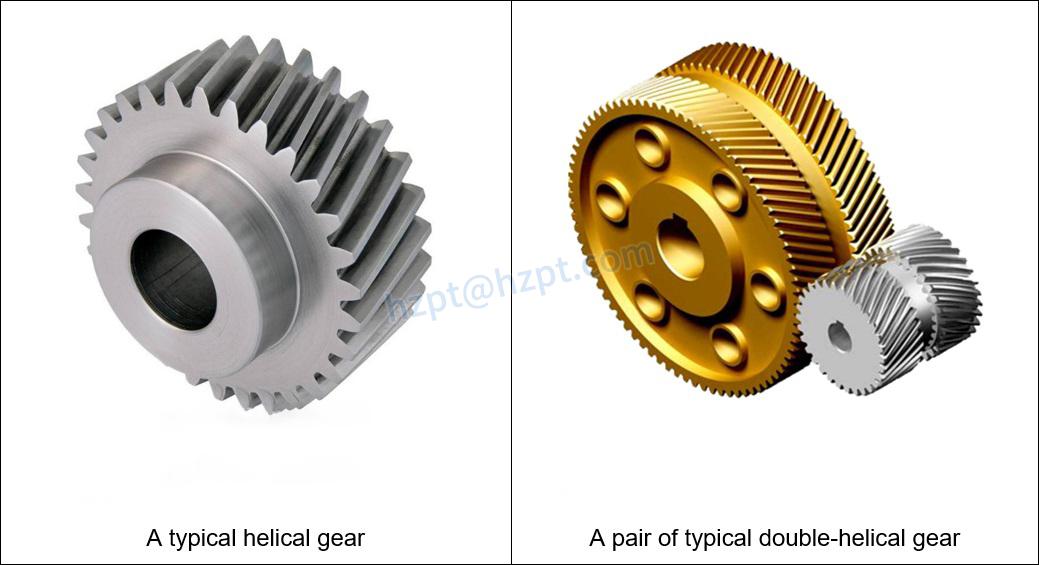

| Single Helical Gear | Double Helical Gear |
|---|---|
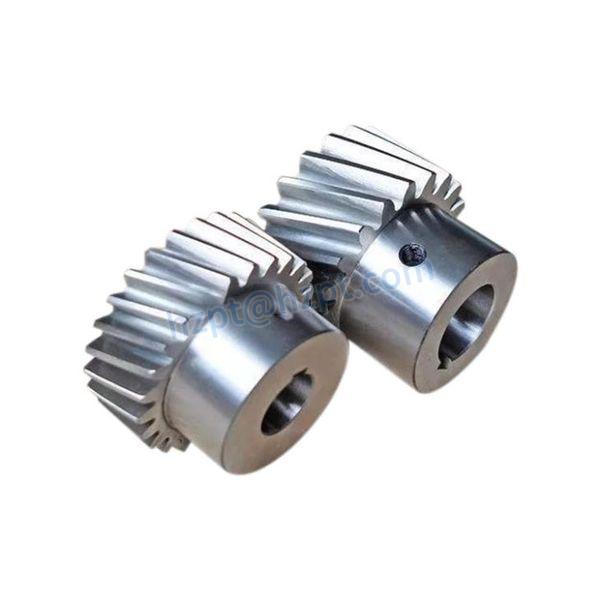
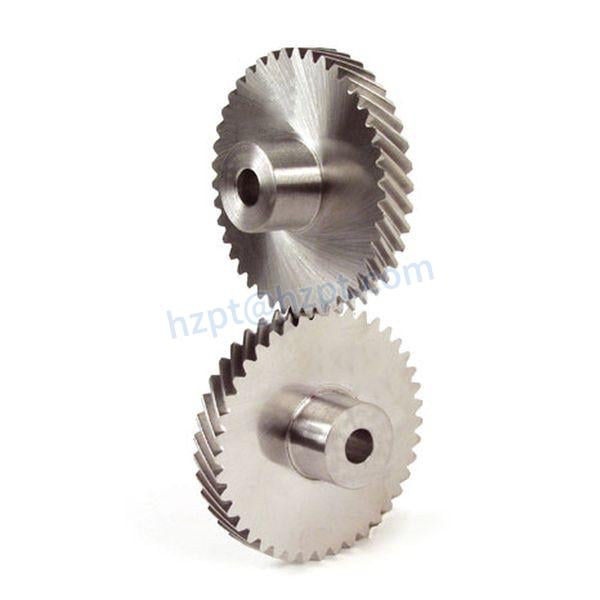
| A single helical gear has teeth inclined in any one direction (either left-hand helix or right-hand helix). | The double-helical gear consists of two identical gears jointed on the same axis and teeth in opposite directions (one has a left-hand helix, and the other has a right-hand helix). |
| Single helical gears develop axial thrust force and exert the same on corresponding bearings. It also generates radial force. | The resultant thrust force developed in double helical gear is zero. Thus it exerts no axial load on bearings. But radial force exists as usual. |
| The power transmission capacity of a single helical gear is comparatively low. | Double helical gears can transmit more significant power for exact size and module. |
| Single helical gears are cheaper. | Double helical gears are costlier as design and fabrication are complex and time-consuming. |
| High precision is usually not desired during the alignment of the gears. | Two helical gears must be aligned precisely; otherwise, thrust force will not balance properly, resulting in a negative vibration. |
| Because of thrust load, a high helix angle cannot be used. Helix angle for single helical gear usually varies from 15º – to 20º. | Due to the canceled thrust load, a high helix angle (20º – 45º) can be advantageously used in double helical gears. |
| The efficiency of single helical gear is comparatively low. | Double helical gears can provide higher efficiency. |
| The bearing span (distance between two bearings) is short. | The bearing span is longer due to a central relief groove in between two gears. |
| Single helical gears are suitable for mechanical drives or power transmission requirements, where each application usually requires a unique design for powers, speeds, and configuration. | Double helical gears are suitable for high power transmission requirements in cranes, marine drives, or turbines. |
Address
Luotuo Industrial Area, Zhenhai District, Ningbo City, China
Tel

 Raydafon