
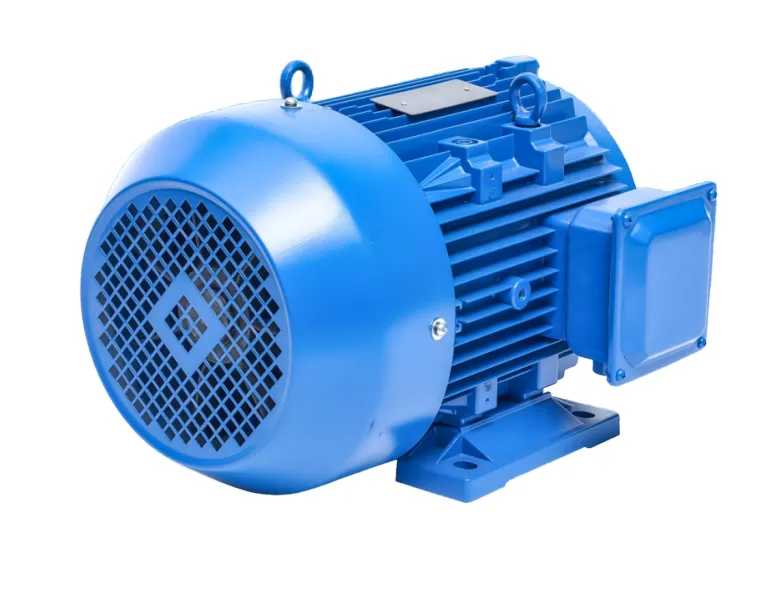
A totally enclosed, fan-cooled squirrel-cage induction motor built to IE3 premium efficiency. Manufactured by Raydafon in cast iron frames from H80 to H400, with output from 0.55 kW to 375 kW and up to 500 kW in customised variants, at 380 V / 400 V / 415 V, 50 Hz. Certified to IEC 60034-30-1 and GB 18613-2020 grade 3 efficiency, with IP55 protection and Class F insulation as standard.
An IE3 motor is a three-phase asynchronous motor whose efficiency sits in the premium tier defined by IEC 60034-30-1 — roughly three to five percentage points above an equivalent IE2 machine at the same output. On a 15 kW drive running continuously, that gap is worth around 1,500 kWh a year, which is why IE3 has become the effective minimum for new industrial installations across most export markets. This series applies that efficiency class across a standard range of 0.55 kW to 375 kW, in frame sizes from H80 to H400.
The construction is conventional in the best sense: a cast iron frame, cold-rolled silicon steel laminations to keep magnetic losses low, a squirrel-cage rotor with no slip rings or brushes, and grease-lubricated deep groove ball bearings. Totally enclosed and self-ventilated to IC411, it carries IP55 protection and Class F insulation rated for 155 °C, and is designed for operation up to 1,000 m altitude at ambient temperatures from −15 °C to +40 °C. Related drives from the same supplier include the AC motor range, the brake motor variant with an integrated fail-safe brake, and gearboxes for combined motor-reducer packages.
The table below shows selected 4-pole models at nominal 1500 rpm synchronous speed across the range, from 0.75 kW to 132 kW. Intermediate ratings, 2-pole, 6-pole and 8-pole versions, and other frame sizes are available on request.
Selected 4-pole models. Scroll the table sideways on a mobile device to read every column.
| Model |
Power (kW) |
Speed (rpm) |
Current (A) |
Voltage (V) |
Efficiency (%) |
Power factor (cos φ) |
Starting torque (Tst/Tn) |
Max torque (Tm/Tn) |
Weight (kg) |
Noise dB(A) |
|---|---|---|---|---|---|---|---|---|---|---|
| IE3-80M2-4 | 0.75 | 1390 | 1.84 | 380 | 82.5 | 0.75 | 2.3 | 2.3 | 19 | 56 |
| IE3-132S-4 | 5.5 | 1440 | 11.2 | 380 | 88.1 | 0.88 | 2.2 | 2.3 | 92 | 77 |
| IE3-200L-4 | 30 | 1470 | 56.63 | 380 | 93.6 | 0.86 | 2.0 | 2.3 | 263 | 76 |
| IE3-315L-4 | 132 | 1480 | 235.5 | 380 | 95.4 | 0.89 | 1.8 | 2.0 | 980 | 83 |

Please note: figures in the table above are catalogue values for typical production and should be confirmed against the nameplate and test report for the specific rating and voltage ordered. Efficiency and current vary with supply voltage and frequency, so state your actual supply conditions when requesting a quotation.
The motor works by electromagnetic induction, with no electrical connection to the rotor. When three-phase AC is applied to the stator windings, the three phases — displaced 120° from each other — produce a magnetic field that rotates at synchronous speed:
Ns = 120 × f / P Ns = synchronous speed (rpm), f = supply frequency (Hz), P = number of poles
At 50 Hz this gives 3000 rpm for 2 poles, 1500 rpm for 4 poles, 1000 rpm for 6 poles and 750 rpm for 8 poles. The rotating field cuts the rotor bars and induces a current in them, and that induced current generates its own magnetic field, which interacts with the stator field to produce torque. The rotor therefore accelerates — a squirrel-cage motor is inherently self-starting and needs no starting winding, capacitor or external excitation.
The rotor never quite reaches synchronous speed, because if it did there would be no relative motion between field and rotor bars, no induced current and no torque. The difference is the slip:
s = (Ns − Nr) / Ns s = slip, Ns = synchronous speed, Nr = actual rotor speed
Slip is typically 2–5 % at rated load, which is why a nominal 1500 rpm 4-pole motor runs at 1440–1480 rpm in the table above. Slip is what makes the machine self-regulating: as load increases, the rotor slows slightly, slip rises, more current is induced and more torque is produced, until the operating point settles where motor torque equals load torque.

The distinction comes down to whether the rotor follows the supply frequency exactly.
For the general industrial duties this series is built for — pumps, fans, compressors, conveyors and machine tools — the induction motor is the more economical answer, and IE3 construction closes most of the efficiency gap that used to justify more complex machines. For related duties, our high voltage motors cover larger drives and the stainless steel motors range suits wash-down and corrosive environments.

The financial case for IE3 rests on a straightforward comparison at the same output. Taking a 15 kW 4-pole motor as an example: an IE3 machine runs at 91.7 % efficiency against 89.4 % for the IE2 equivalent. At full load and continuous duty that difference is worth roughly 1,500 kWh a year — and because the gap widens at partial load and in larger frames, the saving on a 132 kW drive is proportionally greater.
Premium efficiency converts directly into reduced electricity consumption for the same mechanical output. The saving accumulates for the whole service life of the machine, not just the first year, which is why the higher purchase price is normally recovered well within the motor's life.
Self-starting squirrel-cage construction means no starter winding, no capacitor and no external excitation. The motor connects directly to the three-phase supply through a suitable contactor and overload protection.
Class F insulation rated for 155 °C gives thermal headroom above the normal operating temperature, and IP55 protection keeps dust and water jets out of the frame. Low vibration of 1.6–2.8 mm/s reduces wear on bearings and connected machinery.
Cold-rolled silicon steel laminations in the stator and rotor reduce eddy-current and hysteresis losses, which is a large part of where the efficiency gain over older designs comes from.
Grease-lubricated deep groove ball bearings and a brushless rotor mean the maintenance schedule is limited largely to bearing lubrication and periodic insulation checks — no brush or slip-ring servicing.
The motor can be run from a variable frequency drive where the process needs adjustable speed, which for fan and pump duties often saves more energy than the efficiency class alone.
Power factor note: induction motors draw a lagging current, and the power factor rises with frame size — from about 0.75 on the smallest models to 0.89 on the largest in this series. Where the supply authority penalises reactive power, capacitors or a power factor correction unit can be added at the installation. Confirm the supply conditions and any local power quality requirement when specifying.
The IE3 series suits continuous industrial duty where the motor runs for long hours and the electricity bill matters more than the purchase price.
Raydafon is a national high-tech enterprise specialising in ultra-high-efficiency motors, with a registered capital of 20 million RMB and more than 100 employees. The business covers research, development, production and sales of specialised motors including the IE3 series, and the company is recognised as a Specialised, Refined, Unique and Innovative (SRUI) Enterprise. Motors are exported to Europe, the Americas, Asia and Africa.


Verification required before publication: the certification claims, registered capital and employee figures above are reproduced from the source content. Please confirm each against the current certificates and business licence, and insert the certificate numbers, before this page goes live. Unsupported certification claims create commercial and legal exposure in export markets.
Motor price is driven by output, frame size, pole configuration, mounting type, efficiency class and the degree of customisation. Two 30 kW motors can differ substantially in cost once you move from the standard B3 foot mounting to a B5 flange arrangement, add a special shaft, or specify a non-standard voltage for an export market.
Because published price lists go out of date quickly and vary with voltage, mounting and quantity, this page does not quote fixed prices. Send the required output, poles, voltage, mounting type and quantity, and we will return a specific quotation with lead time.

Send the required output, number of poles, supply voltage and frequency, mounting type and quantity. We confirm the frame size and nameplate data, and reply with price and lead time within 24 hours.
Send Inquiry Now* Efficiency, current, power factor, torque ratio, weight and noise figures are catalogue values for typical production and are confirmed against the test report for the ordered rating and voltage. Certification claims and company data should be verified before publication.
Address
Luotuo Industrial Area, Zhenhai District, Ningbo City, China
Tel


 Raydafon