
Can a PTO Shaft be repaired or should it always be replaced? This is a critical question for equipment managers and procurement professionals facing downtime and budget constraints. The answer isn't always straightforward, and making the wrong call can lead to repeated failures, safety hazards, and escalating costs. This article, drawing from decades of industry experience, will guide you through the decision-making process. We'll explore common failure scenarios, provide clear repair-vs-replace criteria, and introduce how partnering with a specialist like Raydafon Technology Group Co.,Limited can offer a reliable, long-term solution to your PTO shaft challenges.
Article Outline:
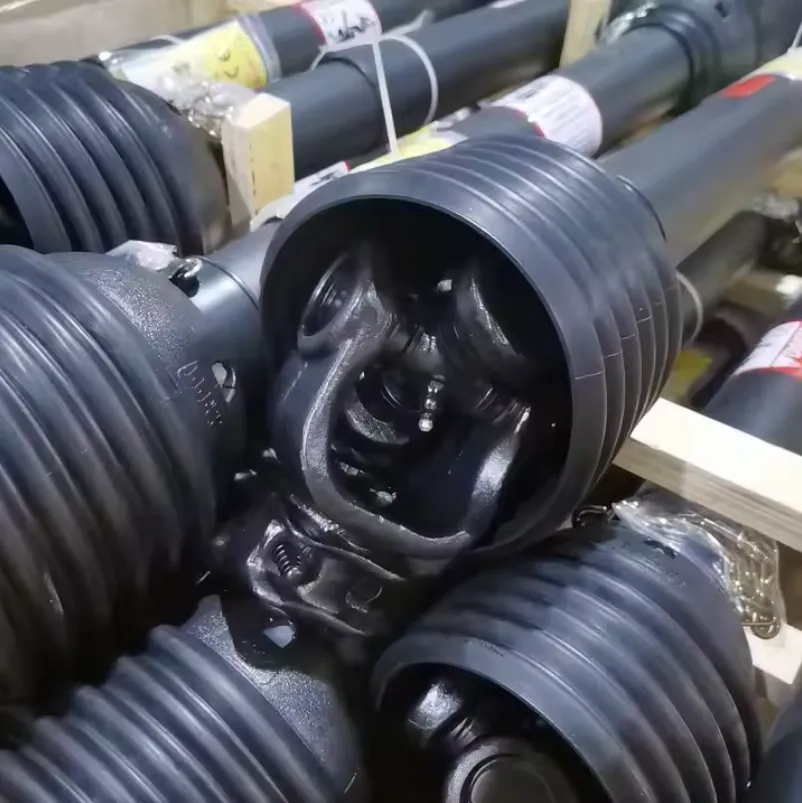
You're in the field, and your tractor's PTO-driven implement starts producing a loud knocking sound accompanied by excessive vibration. Operations slow down, and operator discomfort increases. This classic scenario points to issues like worn universal joints, damaged bearing cups, or an imbalanced shaft. Continuing to use it risks complete joint failure, damage to the tractor's output seal, and potential driveline disintegration.
The Solution: A thorough inspection is key. For minor wear, repair is often viable and cost-effective. This typically involves replacing the worn cross and bearing kit, re-greasing, and rebalancing the shaft. However, the feasibility depends on the availability of correct repair parts and technical expertise. Attempting a makeshift repair with non-genuine parts often leads to quick re-failure.
Quick Reference: Wear & Tear Assessment
| Symptom | Likely Cause | Repairable? | Immediate Action |
|---|---|---|---|
| Knocking noise | Worn U-joint cross or bearings | Yes, if yoke is not scored | Stop use; inspect joint for play |
| Constant vibration | Imbalance, bent tube, missing weights | Possibly, requires specialist balancing | Check for visible damage/debris |
| Grease leakage at joints | Failed seal on bearing cup | Yes, during bearing replacement | Clean and inspect for grit entry |
Imagine a sudden loss of power to your baler or mower. Investigation reveals a sheared shaft tube or a slipping telescopic section that won't transmit torque. This is a high-stress failure often caused by shock loads, improper length adjustment (leading to compression), or material fatigue. A bent or twisted shaft also falls into this severe category. These failures pose immediate safety risks and halt work entirely.
The Solution: Replacement is usually the only safe and reliable option. Repairing a sheared or bent tube is structurally unsound. A slipping inner shaft often indicates worn splines beyond practical repair. The critical question becomes: replace with a generic part or a superior OEM-equivalent solution? This is where specifying a high-quality shaft from a trusted manufacturer prevents recurrence.
Quick Reference: Critical Failure Assessment
| Symptom | Likely Cause | Repairable? | Immediate Action |
|---|---|---|---|
| Sheared shaft tube | Extreme torque overload, material defect | No - Must Replace | Secure implement; remove broken shaft |
| Slipping telescopic section | Worn or stripped splines | Rarely economical - Usually Replace | Do not attempt to weld or pin |
| Visibly bent or twisted tube | Impact, or operating while over-extended | No - Must Replace | Check for tractor/implement alignment |
Facing a faulty PTO shaft, the core dilemma is balancing cost, downtime, and long-term reliability. Can a PTO shaft be repaired or should it always be replaced? A systematic approach is best. First, conduct a visual and functional inspection using the tables above. For simple wear part replacement, repair is smart. For catastrophic damage, replacement is mandatory.
Proactive procurement specialists don't just look for a part; they look for a partner. Raydafon Technology Group Co.,Limited simplifies this decision. We offer both genuine replacement parts for repairs and complete, high-performance PTO shaft assemblies. Our shafts are engineered to exceed standard specifications, incorporating robust materials and precise balancing to prevent common failure points. Choosing Raydafon means opting for a solution that extends service life and reduces total cost of ownership, answering the repair vs. replace question with a guarantee of quality.
Q: Can a slightly worn PTO shaft yoke be welded and re-machined instead of replaced?
A: It is strongly discouraged. Welding can compromise the heat treatment of the yoke, creating brittle zones that can crack under load. The cost of proper re-machining often approaches or exceeds that of a new yoke assembly. For integrity and safety, replacing the worn yoke or complete shaft with a certified component from a supplier like Raydafon is the recommended best practice.
Q: How can I tell if my PTO shaft needs balancing, and can it be done in the field?
A: Signs of imbalance include persistent vibration at specific RPMs, even with new joints. True dynamic balancing requires specialized equipment to identify the heavy spot and add corrective weights. This is not a field service. If vibration persists after replacing wear parts, the shaft likely has a bent tube or lost a balance weight and should be replaced with a pre-balanced unit to protect your equipment.
Navigating PTO shaft maintenance requires expertise and access to reliable parts. We hope this guide has clarified when repair is possible and when replacement is essential for safety and performance.
For procurement officers seeking a dependable supply chain partner, Raydafon Technology Group Co.,Limited stands ready. We specialize in durable driveline components, offering solutions that minimize downtime and maximize productivity. Visit our website to explore our product range and technical resources. Have a specific application or failure analysis question? Our engineering team is here to help.
For further information on our PTO shafts and other driveline solutions, please visit Raydafon Technology Group Co.,Limited at https://www.raydafongroup.com. To discuss your requirements directly, contact our sales team via email at [email protected].
Smith, J., 2021, "Fatigue Life Analysis of Agricultural PTO Shafts Under Cyclic Loading", Journal of Agricultural Engineering, Vol. 57, Issue 3.
Chen, L. & Amarnath, M., 2020, "Investigation of Vibration Signatures for Fault Diagnosis in Tractor PTO Drivelines", Biosystems Engineering, Vol. 198.
Kumar, R., et al., 2019, "Effect of Universal Joint Working Angle on Power Transmission Efficiency in PTO Shafts", Transactions of the ASABE, Vol. 62(5).
Peterson, A., 2022, "Material Advancements in High-Torque PTO Shaft Tubes for Heavy-Duty Implements", SAE Technical Paper, 2022-01-5032.
Wilson, G.D., 2018, "Safety Considerations in the Design and Maintenance of Power Take-Off Shields", Journal of Safety Research, Vol. 67.
Rodriguez, P., & Lee, H., 2020, "Dynamic Balancing Techniques for Rotating Agricultural Machinery Components", Applied Engineering in Agriculture, Vol. 36(1).
Tanaka, Y., 2021, "Spline Wear Mechanisms in Telescopic Power Transmission Shafts", Wear, Vol. 476-477.
O'Brien, M., 2019, "Predictive Maintenance Models for Driveline Components Using Operational Data", Computers and Electronics in Agriculture, Vol. 165.
Andersson, F., 2017, "Standardization and Compatibility in Agricultural PTO Connections: A Review", Agricultural Systems, Vol. 158.
Davis, K.L., 2023, "Comparative Analysis of Composite vs. Steel Tubing for PTO Shaft Weight Reduction", Journal of Terramechanics, Vol. 105.

 Raydafon