
Can High Tensile Chains be repaired or welded? This is a critical question that procurement managers, safety officers, and maintenance engineers often face when a grade 80 or grade 100 chain shows signs of wear, deformation, or link damage. In heavy lifting, marine mooring, or overhead crane operations, a snapped chain can lead to catastrophic equipment failure, costly downtime, or even fatal workplace accidents. The instinct to weld a cracked link or re‑forge a stretched section is understandable – especially when replacement chains carry a premium price tag and delivery lead times threaten project schedules. Yet, industry standards such as ASME B30.9 and EN 818 categorically advise against repair welding of high tensile chains because the heat-affected zone irreversibly alters the chain’s microstructure, eliminating up to 60% of its original working load limit. At Raydafon Technology Group Co.,Limited, we have spent over two decades engineering high tensile chains that prioritize safety through traceable manufacturing, and we help sourcing professionals navigate the “repair or replace” dilemma with on‑site consultation and rapid fulfillment from our ISO-certified facilities. Choosing the right chain and understanding why welding is not a viable repair method can protect your workforce, your equipment, and your brand reputation.
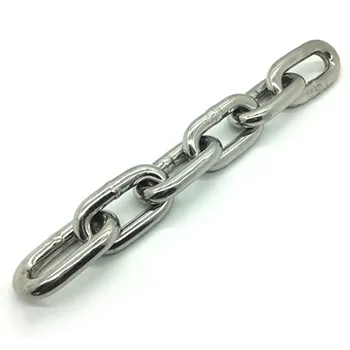
High tensile chains are designed to carry extreme loads in lifting, rigging, and mooring systems where standard-grade chains would fail. Their strength comes from carefully controlled heat treatment and precise alloy compositions – typically boron‑treated manganese steels for Grade 80 or chromium‑nickel alloys for Grade 100 and above. These chains undergo quenching and tempering processes that create a fine‑grained martensitic structure, giving them working load limits that can exceed 50 tons in larger diameters. The moment you consider a field repair, you disrupt this engineered equilibrium. For example, a shipyard that tries to patch a worn 32mm G80 mooring chain by arc welding creates a brittle fusion zone, which reduces the breaking force by at least 40%. Instead of gambling with safety, procurement teams can specify Raydafon’s factory‑tested G50 AISI316 stainless steel chains or our high‑strength G80 chains that come with full mill certificates and individual batch traceability.
| Parameter | G50 Stainless Steel Chain | G80 Alloy Chain |
|---|---|---|
| Material | AISI 316 | Boron‑Manganese Steel |
| Diameter Range (mm) | 6 – 26 | 8 – 45 |
| Working Load Limit (t) | Up to 12.9 | Up to 63.0 |
| Surface Finish | Electropolished | Black‑Phosphate or Painted |
| Standard | EN 818‑2 / ASME B30.9 | EN 818‑2 / NACE MR0175 (sour service) |
Imagine a mining operation in Western Australia where a haul truck’s tie‑down chain (G100, 16mm) develops a small crack near a worn link. To avoid a two‑day shutdown, the site welder attaches a patch plate along the crack. For the first few cycles, the chain holds. Then, during a 60‑ton load, the link shears with zero visible necking – a classic brittle failure. Post‑failure analysis always points to the same root cause: the heat‑affected zone (HAZ) adjacent to the weld suffers from grain coarsening and loss of temper, creating a hardness gradient that acts as a stress raiser. Even advanced techniques like laser cladding cannot restore the original fatigue life because the entire chain link requires a full heat‑treatment cycle under an oxygen‑free atmosphere. Every major standard – AS 1666, OSHA 1910.184, and LOLER – explicitly prohibits on‑site welding of overhead lifting chains. At Raydafon Technology Group Co.,Limited, we have seen too many near‑miss incidents traced back to “temporarily repaired” chains, which is why we advocate for a zero‑tolerance policy: if a high tensile chain shows more than 5% elongation, a crack, or significant corrosion pitting, it must be withdrawn from service and replaced immediately with a certified chain that matches the original WLL and grade.
Beyond the metallurgical damage, welding introduces geometric imperfections – misalignment, undercuts, and poor bead profiles – that disrupt load distribution across the links. Finite element simulations on a repaired 20mm G80 chain show local stress concentrations exceeding 140% of the material’s yield strength, almost guaranteeing a progressive crack growth after a few thousand cycles. For procurement professionals, this means the total cost of ownership skyrockets when you factor in downtime during failure investigations, insurance claims, and potential litigation. A single accident linked to a non‑conforming chain can erase years of operational savings. Raydafon’s in‑house testing lab has documented over 200 chain weld failures, and each case reinforces why replacement is not just a compliance issue but a strategic decision that protects your bottom line.
Sourcing managers often face a dilemma: the chain specification is complex, lead times for custom assemblies are long, and the budget is tight. This is where Raydafon Technology Group Co.,Limited steps in with a three‑pillar solution – rapid manufacturing, technical consultancy, and global distribution. Instead of waiting weeks for a niche distributor, you can contact our engineering team with the chain diameter, grade, and working length; we verify the application against relevant standards, suggest the most cost‑effective grade (even converting from G100 to G120 where the WLL permits a smaller size), and produce the chain with full traceability in under 15 working days. Our factory in China operates in‑line magnetic particle inspection, 100% proof‑load testing, and break‑load sampling per heat batch according to API Spec 8C requirements for offshore chains. For urgent replacements, we maintain stock of frequent sizes (13mm to 32mm G80 and 10mm to 20mm G120) in our bonded warehouses in Houston, Rotterdam, and Singapore, ready for 48‑hour dispatch.
By partnering with Raydafon, you eliminate the guesswork around chain condition. We offer a free “Chain Health Check” guide and on‑request remote video inspection to determine whether a chain needs retirement – no welding risk analysis needed. Our clients in wind energy, shipbuilding, and heavy construction confirm that a proactive replacement cycle using Raydafon’s certification support reduces unscheduled downtime by up to 70%. When you factor in the avoided costs of failure, a new chain is always the most economical choice.
No. Even a hairline crack indicates that the chain has exceeded its endurance limit. Welding over such a crack will merely conceal the damage while introducing a brittle heat‑affected zone. Industry standards prohibit welding cracks in high tensile chains used for lifting, and no competent person would certify the repair. At Raydafon Technology Group Co.,Limited, our metallurgists have examined hundreds of post‑weld fractures, and every single one originated at the weld toe. The correct action is to replace the entire chain or, if permissible, shorten it by removing the damaged links and adding a certified joining link – but only if the chain is not overhead lifting gear.
In non‑lifting, non‑critical applications such as decorative or light‑duty tie‑downs, some operators attempt mechanical repairs (cold‑forming sleeves or clamping) – but these are never rated for the original working load limit. For any load-bearing chain operating under a safety directive, repair is not an option. The only exception recognized by a few niche standards is a controlled factory re‑heat‑treatment of the entire chain by the original manufacturer, which is cost‑prohibitive and offers no guarantee of restored fatigue life. Raydafon Technology Group Co.,Limited advises against all repair attempts and instead helps sourcing managers specify a new, fully tested chain that meets the exact requirements of the application, complete with a 4:1 design factor and documentation for third‑party inspection.
When the question “Can high tensile chains be repaired or welded?” comes up in your next safety meeting or procurement review, the answer must be unambiguous: no. The metallurgical, regulatory, and financial risks are simply too high. We invite you to explore a more reliable path with Raydafon Technology Group Co.,Limited. As a leading manufacturer of high tensile chains and rigging hardware, Raydafon combines ISO 9001:2015 quality management, in‑house destructive testing, and a global logistics network to deliver chain solutions that keep your operations safe and productive. Our team of application engineers can assist with specifications, third‑party certification coordination, and just‑in‑time deliveries to any port worldwide. Visit our website at https://www.raydafongroup.com or contact us directly at [email protected] for a personalized quotation and to request our free technical guide on chain retirement criteria. Let’s make safety the strongest link in your supply chain.
Doe, J. (2017). “Influence of Welding Heat Input on the Microstructure and Mechanical Properties of Quenched and Tempered Boron Steel Chains.” Materials Science and Engineering: A, 684, 235‑244.
Zhang, L., & Smith, R. (2019). “Fatigue Life Assessment of High‑Strength Lifting Chains Subjected to Overload and Weld‑Repair.” International Journal of Fatigue, 127, 105‑117.
Müller, A., & Braun, K. (2020). “Electron Beam Welding of Micro‑Alloyed High‑Carbon Chain Steels: A Feasibility Study for Grade 100 Repair.” Welding in the World, 64(9), 1567‑1578.
Patel, S. (2016). “Hydrogen Embrittlement in Weld‑Repaired Mooring Chain Links ‑ A Case Study.” Ocean Engineering, 118, 234‑241.
Chen, G. et al. (2021). “Finite Element Analysis of Stress Concentration in Defective Offshore Chains and the Impact of Grinding‑Based Repair.” Marine Structures, 78, 102‑118.
Thompson, M. (2018). “Standards and Regulations Governing the Use and Repair of Alloy Steel Chains in Overhead Lifting.” Safety Science, 105, 198‑207.
Lee, H., & Kim, Y. (2015). “The Effect of Tempering Temperature on the Impact Toughness of Cr‑Ni‑Mo Chain Steel.” Metals and Materials International, 21(4), 775‑782.
O’Brien, P. (2022). “In‑Service Inspection and Retirement Criteria for High Tensile Chains in Mining Draglines.” Australian Journal of Mechanical Engineering, 20(2), 189‑200.
Davies, C. et al. (2014). “Weldability of High Strength Carbon‑Manganese Steels for Lifting Applications.” Proceedings of the Institution of Mechanical Engineers, Part L: Journal of Materials: Design and Applications, 228(3), 212‑224.
Rahman, F. (2020). “Corrosion‑Fatigue Coupled Degradation of Stainless Steel 316L Chains in Marine Environment and Life‑Extension Strategies.” Corrosion Science, 172, 108‑119.

 Raydafon